Kitchen Tools
Japanese Cutting Boards: What's Actually Under the Knife (Not Always Wood)
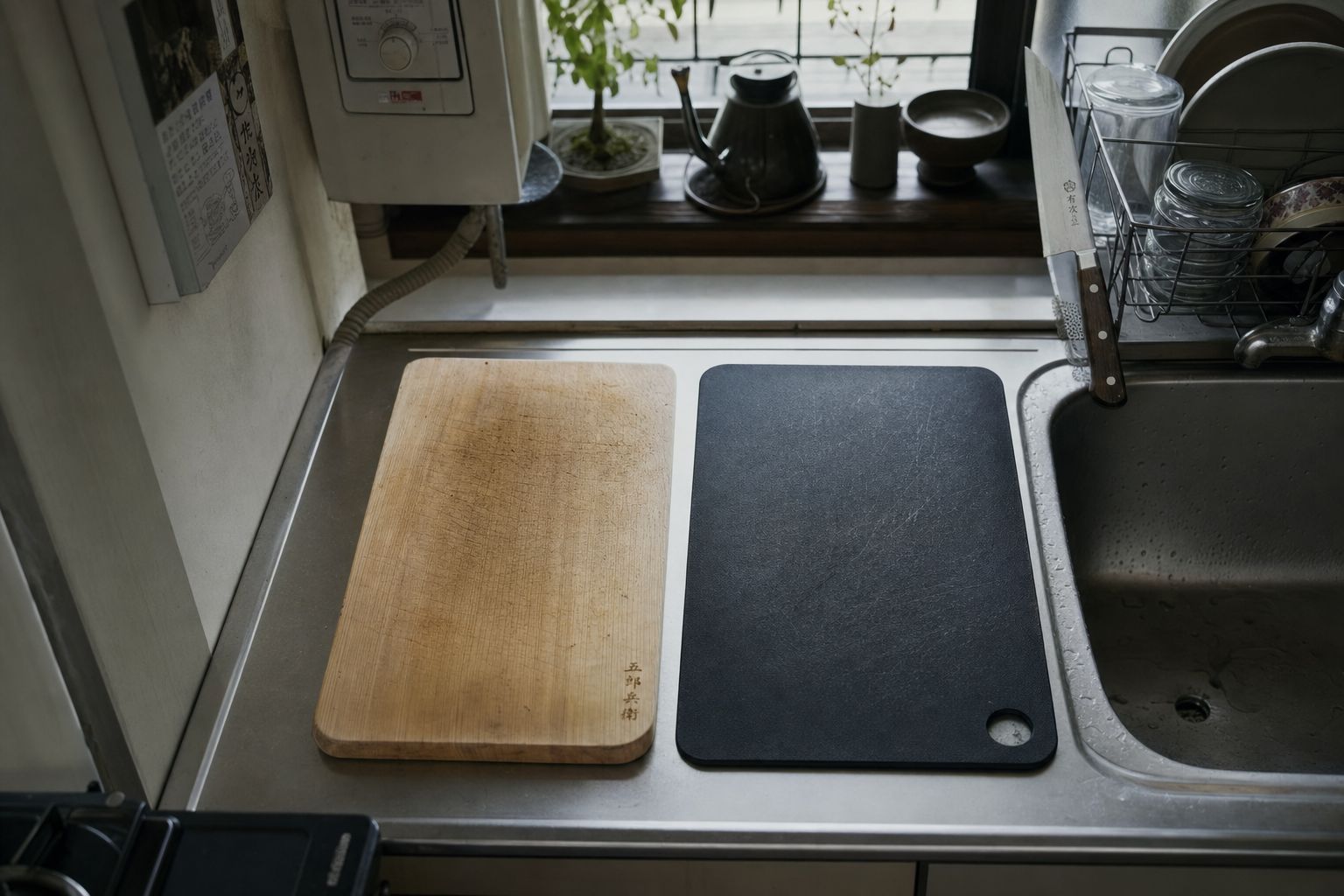
If you picture a Japanese kitchen, you probably picture a thick block of pale wood under the knife — the kind sold in gift shops as “hinoki cutting board, handmade in Japan.” I own one. I also almost never reach for it.
The short answer: a lot of Japanese kitchens, home and professional, are cutting on rubber or plain polyethylene plastic more often than the gift-shop version of Japan suggests. Wood is the romantic answer. Rubber is the everyday one, more than the export catalogs let on. If you want one board for daily meat and fish work, buy antibacterial rubber. If you want the classic feel and don’t mind the upkeep, buy hinoki and use it for vegetables and bread. Skip glass entirely — it will dull your knife inside a week, no matter how expensive the knife.
My own kitchen is a Tokyo apartment galley, which means counter space for cutting boards is a single narrow strip next to the sink. There’s no room for the American setup of four color-coded boards, one per food group. Most households here own one everyday board and maybe a second smaller one, both stored standing up in a slotted rack by the sink rather than laid flat — partly for hygiene, mostly because there’s nowhere else to put them.
Why the wood story is only half true
Wood boards are still common here, especially inherited ones. My grandmother’s board was a slab of pale wood, dished down the middle from forty years of the same santoku hitting the same six inches of surface. She stood it on its edge to dry, propped behind the flour tin, and I never once saw mold on it — because it never lay flat and wet overnight. That single habit is most of what “good wood board care” actually is.
But professional kitchens moved on decades ago. Sushi counters, kaiseki kitchens, and most restaurant back-of-house in Japan now cut on synthetic rubber, not wood. The best-known brand is Asahi’s Cookin’ Cut — an antibacterial synthetic rubber board that’s compliant with Japan’s Food Sanitation Act, doesn’t absorb water or juice the way wood does, and still gives a soft, forgiving surface that’s kind to an edge. It costs real money — roughly $79 to $259 on Amazon depending on size — which is why home cooks here tend to own exactly one, treated as a real purchase instead of a grocery-store impulse buy.
There’s also a genuinely obscure trick worth knowing, because almost nobody outside Japan does: peel-type multi-layer cutting boards. Tenryo makes them, sold through Hocho Knife’s cutting board section among others — a polyethylene board built in stacked layers (commonly four to eight peelable 5mm layers over a thicker base), bonded by heat instead of glue. When the surface gets too scarred to clean properly, you score along a seam with the tip of a knife and peel that top layer away, and the board underneath is fresh again. Restaurant kitchens use it instead of resurfacing or replacing the whole board, and it’s marketed in Japan partly on those environmental grounds — one board doing the job of several without going in the trash each time.
It sounds like a gimmick until you’ve actually watched someone do it in about four seconds. It’s exactly the kind of practical, unglamorous detail that never makes it into a gift-shop guide to Japan — nobody photographs a professional kitchen’s supply cabinet.
The honest comparison
| Material | Best for | Care | Roughly |
|---|---|---|---|
| Antibacterial rubber (Asahi Cookin’ Cut) | Meat, fish, daily heavy use | Dishwasher-safe, doesn’t warp | $79–$259 |
| Hinoki wood | Vegetables, bread, the feel of it | Hand wash, dry standing up, occasional oil | ¥3,000 to ¥30,000 |
| Plain polyethylene plastic | Everyday budget board | Dishwasher-safe, replace when scarred | ¥110–¥2,000 |
| Tenryo peel-type layered board | Restaurant-style hygiene without buying new | Peel a layer with a knife when worn | Priced by size at specialty retailers |
| Glass or stone | Nothing. Don’t. | — | — |
| Thin bamboo (glued strips) | Cheese or bread board only | Hand wash | Cheap, and it shows |
That table is a durability decision, not a taste decision. Bamboo boards look nice in photos, but most are made of thin strips glued under pressure, and the glue line runs harder than the bamboo itself — every pass of the knife hits a seam slightly tougher than the wood on either side of it. Fine for cheese and bread. Rough on an edge you paid for.
Where people actually go wrong
The mistake with wood isn’t buying it — it’s leaving it flat on the counter, wet, overnight. That’s how a board warps or, worse, grows something in the grain. Stand it up. That’s the whole fix.
The mistake with rubber is over-bleaching it. It resists odor and bacteria on its own, so a quick rinse and occasional dish soap does the job; scrubbing it with straight bleach every use breaks the surface down faster than normal knife wear would.
The mistake with plastic is waiting too long to replace it. Once a board is scored deep enough to hold what Japanese kitchen shops call kizu (傷 — cut scars, the visible grooves), no amount of washing gets a sponge into every groove. A ¥1,000 plastic board is cheap enough that “replace it” isn’t really advice, it’s just math.
And the mistake with glass is buying it at all. It looks clean, it wipes down easily, and it will take the edge off a $150 gyuto faster than a whole year of normal cutting. I have never seen one in a Japanese kitchen, home or professional.
So don’t.
What I’d actually tell you to buy
If you read the knife brand breakdown on this site, you already saw the short version of this advice: wood or decent plastic, always, never glass. Everything above is the longer answer, and the part that guide didn’t have room for — where rubber fits in, and why a lot of the kitchens that inspired that gift-shop image of Japan aren’t actually using wood day to day anymore.
If you already went through the trouble of choosing the right steel and learning how to keep it sharp, the board matters just as much as either of those did — it’s the surface your edge meets thousands of times before you ever touch a stone again.
For most people reading this, I’d say: buy one mid-size antibacterial rubber board for the knife work that actually happens every night — onions, chicken thighs, fish — and if you want the hinoki experience too, get a smaller one for bread and vegetables where the softer wood feel is nicer and the stakes are lower. You don’t need both on day one. You need to not be cutting on glass.
The board under the knife never gets photographed for the gift-shop version of Japan. It’s also the one decision in this whole setup that actually protects the knife you spent real money on.
Want the short version?
The One-Knife Kitchen: how to choose and care for the single Japanese knife that replaces the block — free, printable, one page.
Send me the free guide →