Knives
Japanese Knife Steel, Decoded: VG-10, Shirogami, Ginsan and SG2
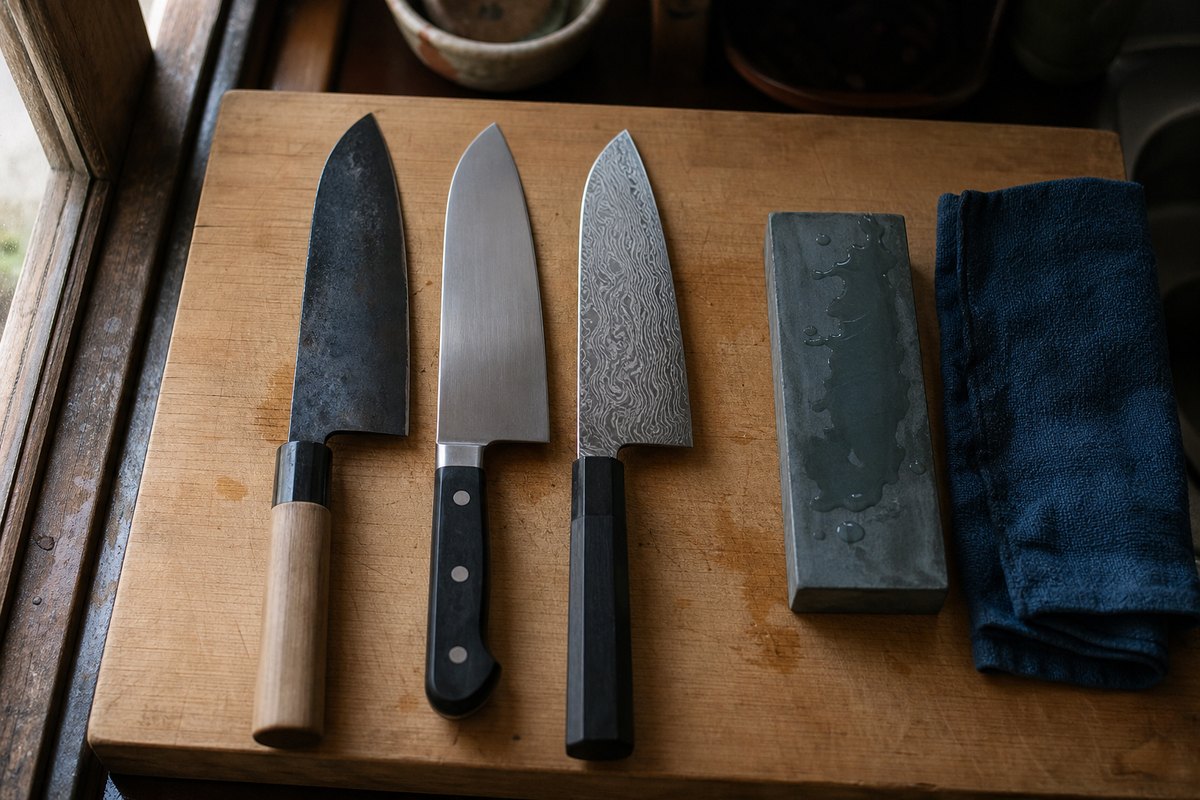
Most Japanese knifemakers don’t make their own steel. They buy it, and a large share of it comes from two mills — one in Shimane, one in Fukui. Two knives from different workshops, in different cities, at prices $150 apart, are often built around exactly the same metal.
Which is why the steel name in a product listing is the one line on the page that tells you something concrete. It’s also the line that sends first-time buyers into a three-hour forum spiral and out the other end with a beautiful knife they’re now scared to use.
The short answer: buy stainless. VG-10 or Ginsan, hardened somewhere around 60 HRC. Both take an edge that will embarrass whatever is in your drawer, and neither punishes you for leaving the blade on the drainer while the rice finishes. Carbon steel — shirogami, aogami — is sharper and considerably more work. It makes an excellent second knife.
Where these names come from
There are two families, and once you know them the listings stop looking like alphabet soup.
Yasugi steel (安来鋼) is made by Proterial — the company was Hitachi Metals until it was renamed in 2023, so you’ll see both names in shop copy — at its works in Yasugi, Shimane Prefecture. This family gives us shirogami (white paper), aogami (blue paper), and ginsan / gingami #3 (silver paper). The names are exactly as mundane as they sound: the mill wrapped each grade in a different colour of paper for shipping, and the colour stuck. No poetry, no ceremony, just warehouse logistics from a century ago.
Takefu Special Steel sits in Echizen, Fukui Prefecture, in the middle of one of Japan’s old blade-making towns. This is where VG-10 and SG2 come from — both stainless, both engineered rather than inherited.
The decoder table
| Steel | Rusts? | Typical hardness | What it feels like | Who should buy it |
|---|---|---|---|---|
| VG-10 | No | ~60–61 HRC | Sharp, tough, unbothered by neglect | Almost everyone, first knife |
| Ginsan (Silver #3) | No | ~59–61 HRC | Sharpens like carbon, behaves like stainless | People who enjoy the stone |
| Shirogami #2 (White) | Yes, eagerly | ~60–63 HRC | The keenest edge available; loses it soonest | Traditional cooks, sushi work |
| Aogami #2 (Blue) | Yes, slightly less | ~61–63 HRC | Holds an edge much longer; stubborner to sharpen | Carbon people who cook daily |
| SG2 / R2 | No | ~62–64 HRC | Stays sharp for months; chips if you’re rough | The upgrade, two knives in |
A few notes on that table, because the rows hide some real differences.
Shirogami is essentially iron and carbon with the impurities stripped out. That purity is why it takes such a fine edge and why it gives that edge up so quickly. Aogami is the same recipe with tungsten and chromium added — the chromium is also why blue steel resists rust marginally better than white, though “marginally” is doing heavy lifting there. Both will show orange spots overnight if you put them away damp.
Ginsan is the quiet hero of this list. Around 0.95–1.1% carbon with 13–14.5% chromium, it sharpens with the responsive feel of carbon steel and then refuses to rust. If you’ve read that stainless “can’t get properly sharp,” ginsan is the counter-argument, and it’s what I’d point most people toward once they’ve sharpened a knife a few times and started to enjoy it.
SG2 is powdered steel, which means the carbides are distributed more evenly than in conventionally cast steel, which in turn means a finer edge that lasts. Shops routinely claim two to three times the edge retention of VG-10; treat that as directional rather than a measurement. What I’d trust more is the trade-off: it takes noticeably longer to bring back on a standard waterstone, and at 63 HRC it is less forgiving of a knuckle-height chop into a frozen block of anything.
The one number worth understanding
HRC — Rockwell hardness. A German chef’s knife in X50CrMoV15, the steel in most Wüsthof and Zwilling blades, sits around 56–57 HRC. Japanese knives generally start at 58 and run past 62.
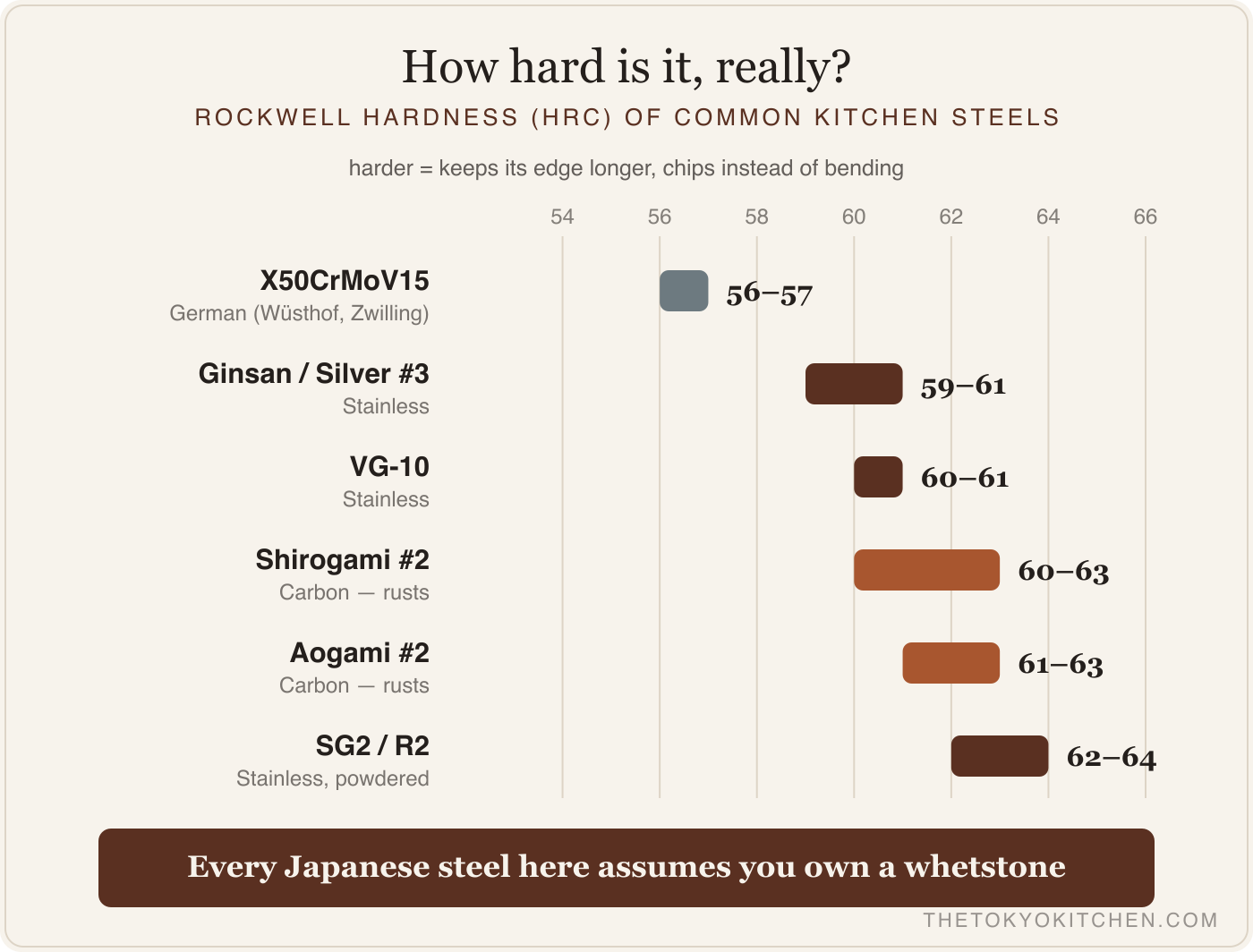
That gap explains the entire personality difference. Harder steel holds a thinner, sharper edge for far longer. Harder steel also chips instead of bending when you hit something it doesn’t like — a chicken bone, a frozen edamame pod, the moment you twist the blade to pop a carrot apart.
Softer German steel dulls faster and rolls rather than chips, which makes it easier to live with and impossible to make truly, unreasonably sharp.
Neither is better. They’re different bargains, and Japan’s bargain assumes you own a stone.
What’s actually in Japanese kitchens
Here is the part the glossy import shops leave out: the standard knife in a normal Japanese home is stainless, costs about ¥3,000 at a home center, and has a plastic handle.
Kai’s Seki Magoroku line is the one you’ll see most, stacked on pegboard in the kitchenware aisle of any home center. It runs to dozens of models; the everyday ones carry “ST” in the name and are stainless, and a smaller range labelled hongane (本鋼, “true carbon steel”) exists for people who want that instead. The stainless ones are what end up in most households, and they are genuinely fine. Nobody in my building is cooking dinner with aogami.
Carbon steel does live on here, and my grandparents’ kitchen had one. It was a dark, slightly ugly blade that got wiped with a dry cloth every single time it touched water, without anyone thinking about it. That habit is the actual price of carbon steel — not the money, the two seconds, every time, forever. Miss it three times and you own a rust problem instead of a knife.
I’ve also bought the cheap thing and regretted it, so I want to be careful about what that lesson was. It wasn’t “cheap steel is bad.” Japan’s mass-market makers are good, and I’d happily cook with a ¥3,000 Seki Magoroku for the rest of my life. The regret came from buying a knife whose listing didn’t name a steel at all. When a shop won’t tell you what’s inside, there’s usually a reason.
The patterns are the jacket, not the steel
Most Japanese knives are san-mai — three layers. A hard core steel is sandwiched between two softer stainless outer layers. The core does the cutting; the cladding adds toughness and keeps the expensive stuff to a minimum.
Everything you see on the outside of the blade is that cladding:
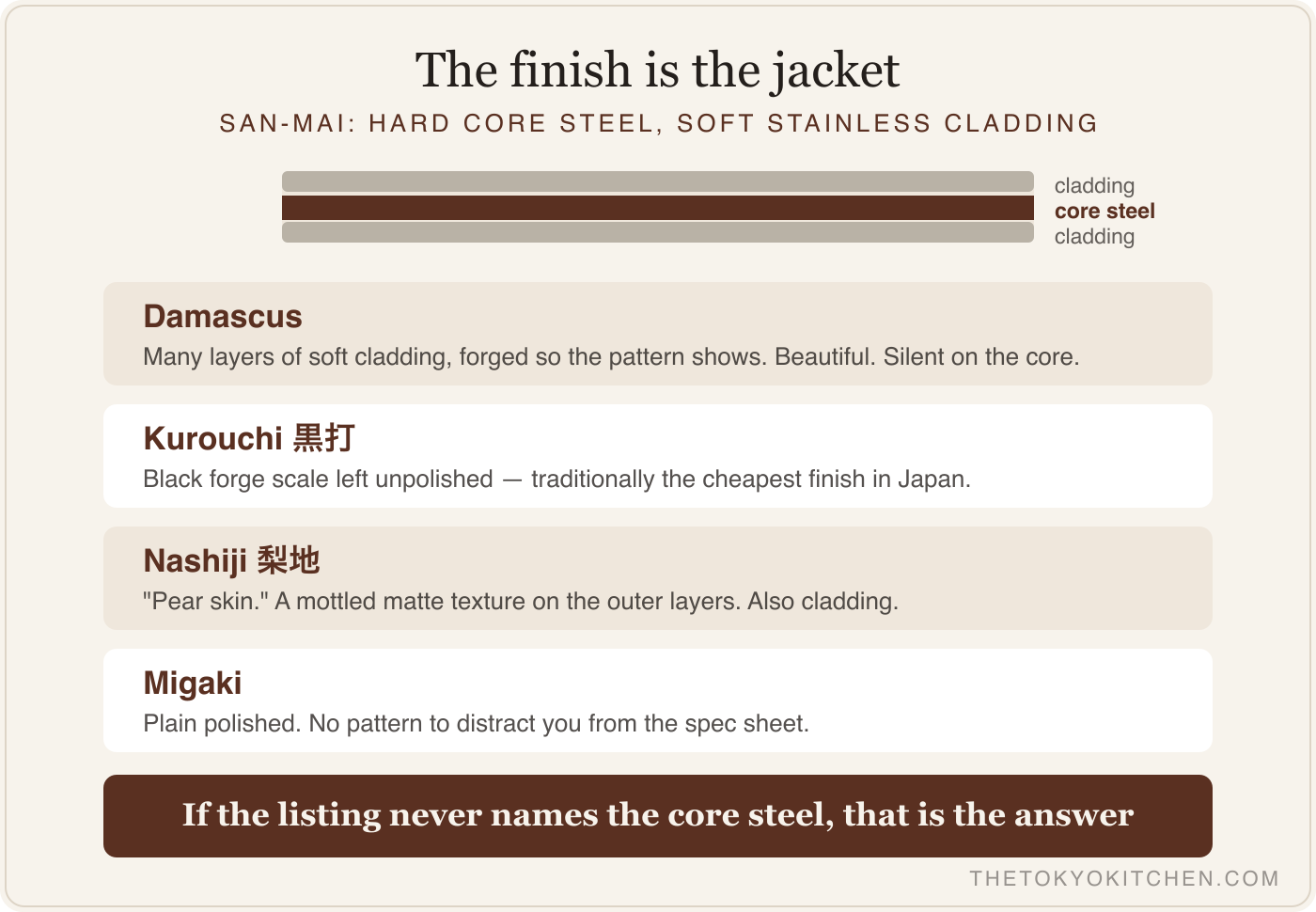
- Damascus — many layers of soft cladding, forged and ground so the layers show as waves. Beautiful. Says nothing about the core.
- Kurouchi (黒打) — the black forge scale left unpolished. It’s the unfinished finish, traditionally the cheapest option, now sold at a premium abroad because it photographs well.
- Nashiji (梨地) — “pear skin,” a mottled matte texture. Also cladding. Also silent on the core.
- Migaki — plain polished. The one that tells you the maker had nothing to distract you with.
So the rule when you’re comparing two listings: find the core steel. If a knife is described only as “Damascus stainless steel,” you’re being sold the wrapping paper. (Hocho Knife’s damascus section lists the core steel on nearly every product — a decent way to train your eye on what a complete listing looks like.)
Three ways this goes wrong
Buying carbon as a first knife. It’s the most seductive mistake because the internet’s most passionate knife people all cook on carbon. They also have the habits. Give a new shirogami blade a week of onions and lemons and the blade darkens to a blotchy blue-grey, while acidic food picks up a faint metallic edge where it was cut. Both are iron reacting, both fade as the patina matures over a few weeks of use, and both are a lot to explain to your family on a Tuesday.
Paying for the pattern. Covered above, but worth repeating because it’s where the most money goes astray. Our brand guide has the same warning for the same reason.
Buying steel your stone can’t keep up with. SG2 at 64 HRC is wonderful right up until it dulls, at which point a basic #1000 waterstone and ten minutes turns into twenty-five and some swearing. If you haven’t yet built the sharpening habit, start on VG-10 — it comes back fast and forgives an inconsistent angle.
So, which one
Pick your shape first — that’s the santoku or gyuto question, and it matters more than the steel. Then:
- First Japanese knife, no sharpening experience → VG-10.
- You already sharpen and want a nicer edge → Ginsan.
- You cook daily, wipe things dry reflexively, and like a project → Aogami #2.
- Second or third knife, budget is not the constraint → SG2.
- You want the sharpest possible edge and accept the maintenance → Shirogami #2, from a traditional maker. Hocho Knife carries a lot of these and ships from Japan.
There’s no wrong answer on that list, only mismatched ones. The knife that ruins people isn’t the cheap one — it’s the expensive one bought for a kitchen habit its owner doesn’t have yet.
What’s on the spine of the knife you’re using tonight? If the listing was vague and you’ve been wondering what you actually bought, send me the model and I’ll tell you what I can find out about it.
And if you’re still at the “which knife at all” stage, The One-Knife Kitchen is the free one-page version of all of this — what to buy, how to keep it, nothing else.
— Sen
Want the short version?
The One-Knife Kitchen: how to choose and care for the single Japanese knife that replaces the block — free, printable, one page.
Send me the free guide →