Knives
Nakiri Knife, Explained: The Vegetable Blade Japanese Kitchens Add Second
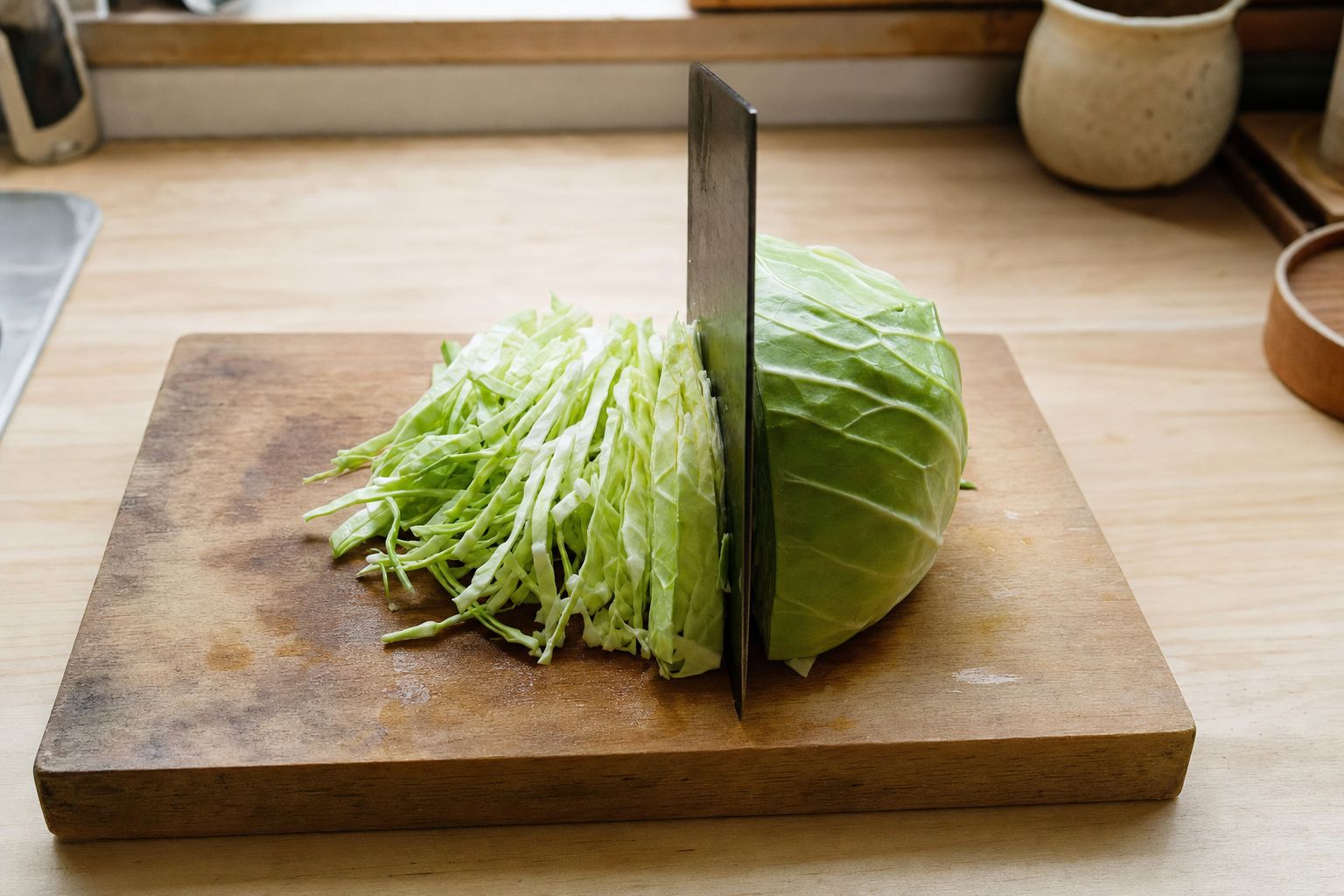
Every Japanese knife guide, mine included, eventually says the same thing: buy one knife, learn it, stop shopping. My own advice on santoku versus gyuto ends on exactly that note. So it’s a little strange that the second knife most Japanese households actually add isn’t a bigger gyuto or a fancier santoku. It’s a flat rectangle of steel that can’t stab or pierce anything, and looks, frankly, like a small cleaver that lost a fight.
That’s the nakiri. And the honest answer to “do you need one” is: probably not, but here’s why some people genuinely do.
The short version: a nakiri is a double-bevel vegetable knife with a flat edge and no point, built for chopping straight down through vegetables in volume — cabbage, daikon, a pile of onions for a big pot of curry. If your santoku already handles your vegetable work fine, skip it. If you cook a lot of vegetables in bulk and your wrist is tired of rocking a curved blade through them, it earns its drawer space.
What a nakiri actually is
Picture a rectangle, roughly 16 to 18 centimeters long, with a straight bottom edge and almost no curve. Unlike a santoku or gyuto, there’s no point to speak of — the corner is close to a right angle. That flat profile is the entire design idea: instead of rocking the blade heel-to-tip through food the way you would with a curved edge, you press straight down, lift, and move over. No sawing, no rocking, no bruising the cut face of a cabbage leaf by dragging the edge through it at an angle.
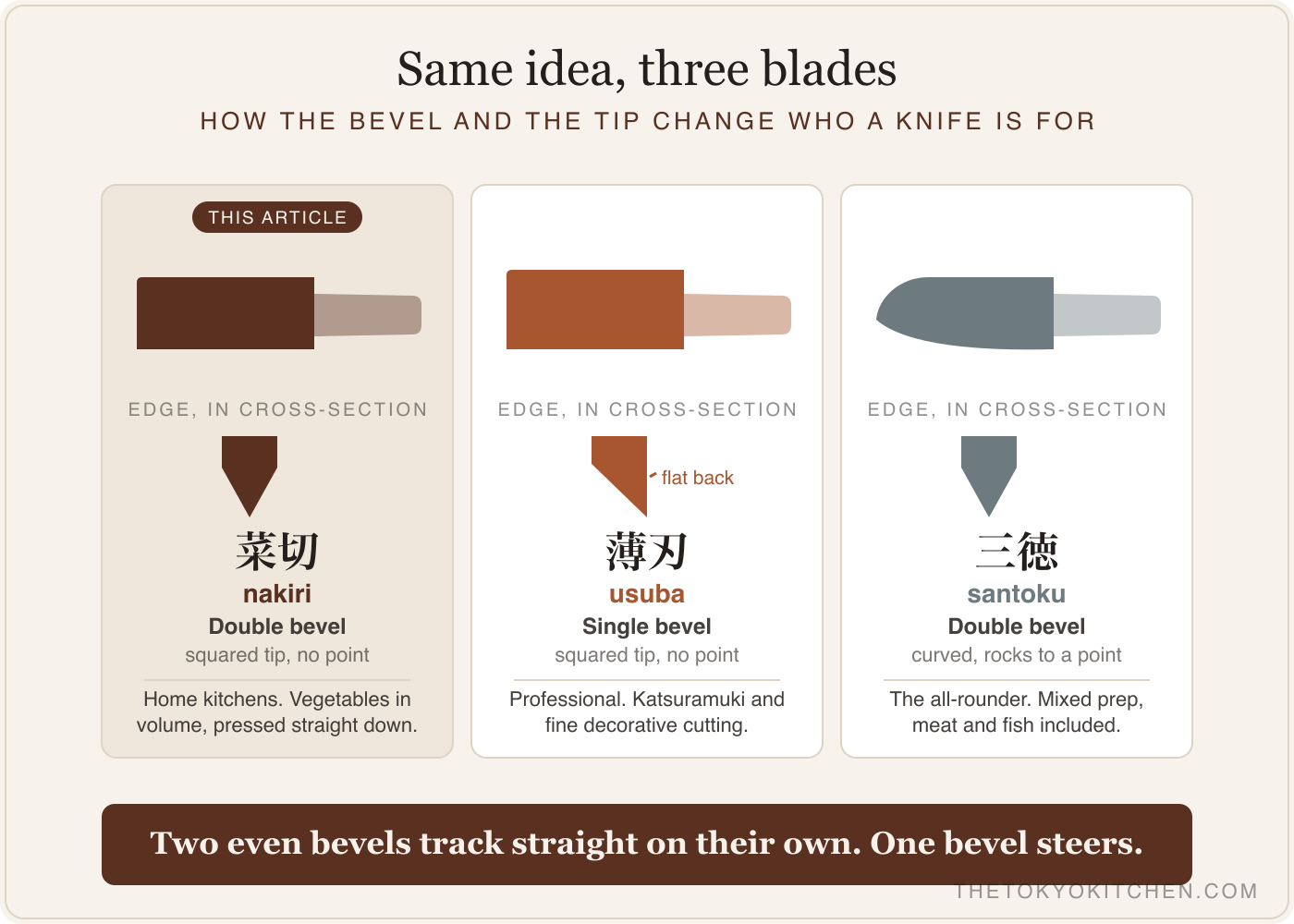
It’s a double-bevel knife, ground on both sides like a Western chef’s knife, which matters more than it sounds like it should. It puts the nakiri in the same maintenance category as the knife you already own — same stone, same angle-by-feel method, no new skill required.
The professional shadow behind it: usuba
The nakiri exists because of a knife most home cooks will never own: the usuba, a single-bevel vegetable knife that’s the traditional, professional version of the same idea. Where the nakiri is ground evenly on both sides, the usuba is ground almost entirely on one — the flat back face barely touches the sharpening stone at all. That single bevel is what lets a trained chef perform katsuramuki, the technique where a cylinder of daikon is peeled into one continuous, translucent sheet thin enough to see through, without ever lifting the blade. It’s one of the standard tests culinary schools in Japan use to check a student’s knife control, and it takes real years to get good at.
A single-bevel blade also steers. Pushed straight down, it pulls slightly to one side unless you compensate, which is exactly the kind of “extra thing to think about” that has no business in a home kitchen on a Tuesday. The nakiri strips that out. Two even bevels track straight on their own, the way a Western knife does, and that’s the whole reason it exists as a separate, friendlier category instead of everyone just learning the usuba.
So: usuba is the sushi-counter tool. Nakiri is what that same idea looks like once it’s been made forgiving enough for the rest of us.
Why the flat edge is the whole point
A curved blade like a santoku or gyuto is built to rock — heel down, roll forward to the tip, repeat, which is efficient for mixed prep where you’re switching between mincing garlic and breaking down a chicken thigh in the same five minutes. But rocking a curved edge through a wide, flat vegetable means the middle of the cut arrives at an angle, and on something like cabbage that shows up as a slightly torn, bruised face instead of a clean one.
Straight down and lift avoids that entirely. It’s also less tiring on the wrist over volume — if you’re working through a whole daikon into rounds, or a full head of cabbage into shreds for okonomiyaki, a flat press-cut motion repeats with almost no wrist rotation, where a rocking motion asks your wrist to do the same small pivot a hundred times in a row.
That’s the actual case for owning one. Not “sharper,” not “more traditional” — just less physically repetitive for a specific, high-volume kind of cutting.
What it’s bad at
Here’s the part most nakiri write-ups skip, because they’re usually written to sell you the knife: a nakiri is a poor all-rounder, and a genuinely bad choice as your only knife.
No tip means no piercing — you can’t score a squash or debone a chicken thigh with the corner the way you would with a santoku’s rounded point. Mincing garlic point-down and rocking through it, a two-second motion with a curved blade, doesn’t really work with a flat edge; you end up chopping it in an awkward, flatter motion instead. And it’s a specialist by design, which means it sits in the drawer doing nothing on the days you’re not processing a real quantity of vegetables.
If you only own one knife and are choosing your first, this isn’t it. The santoku or gyuto question is still the one to answer first.
What I actually do
I don’t own a nakiri. My kitchen is a Tokyo apartment galley with one usable drawer for knives, and most nights I’m cutting a bit of everything — chicken, an onion, maybe fish — not working through a whole cabbage. For that mix, a santoku already does the job, and a second specialist blade would mostly just take up the one drawer I have.
My grandparents’ kitchen, though, ran differently. There was the everyday carbon-steel knife I’ve mentioned before — the one that got a dry cloth wipe every single time it touched water — and a second blade kept in the same drawer, flatter and more rectangular, that only ever came out for daikon and cabbage. Two knives, and no overlap between them. My grandmother cooked from vegetables far more, and in far greater bulk, than I do most weeks, and the second knife made sense for exactly that reason. It wasn’t an upgrade. It was a knife for a kind of cooking I don’t do very often.
That’s the actual test, more than any spec sheet: how much volume vegetable prep is genuinely eating into your week. If the answer is “most nights, in real quantity,” a nakiri saves your wrist. If it’s “sometimes,” your first knife already has it covered.
Where nakiri knives actually land, price-wise
A plain stainless nakiri from a home-center brand like Kai’s Seki Magoroku line runs about ¥2,000 to ¥5,000 in Japan — the same everyday tier as the ¥3,000 santoku I’ve mentioned before, because it’s built for the same kind of household. Step up to an imported specialty line and the price moves with it: a Tojiro DP nakiri, the same VG-10 stainless series recommended as a first Japanese knife, runs roughly $90 to $140 depending on finish — hammered and Damascus versions sit at the higher end of that for looks, not performance.
| Tier | Example | Roughly | Who it’s for |
|---|---|---|---|
| Home-center basic | Kai Seki Magoroku, stainless | ¥2,000–¥5,000 | Someone testing whether they’ll actually use a second knife |
| Imported specialty | Tojiro DP, VG-10 | $90–$140 | Someone who already sharpens and cooks vegetables in volume |
If you’re already ordering from a Japanese knife specialist for your main knife or a stone, put it on the same order instead of paying international shipping twice. Hocho Knife’s nakiri and usuba section stocks both, including the single-bevel usuba if the section above made you curious — the shipping math works the same way it does for a whetstone bought alongside a first knife.
The honest recommendation
Don’t buy a nakiri to complete a set. Buy one only after you’ve noticed, for real, that a specific kind of prep — big batches of cabbage, daikon, cucumber for pickling — keeps showing up in your week and your current knife feels clumsy for it. Everyone else is better served spending that money on a nicer stone or just cooking a few more dinners with the knife they already have.
It’s not a step up from a santoku. It’s a different tool for a kind of cooking that not everyone does.
— Sen
Want the short version?
The One-Knife Kitchen: how to choose and care for the single Japanese knife that replaces the block — free, printable, one page.
Send me the free guide →