Knives
Deba vs Yanagiba: Japan's Fish Knives, and Why Almost Nobody at Home Owns One
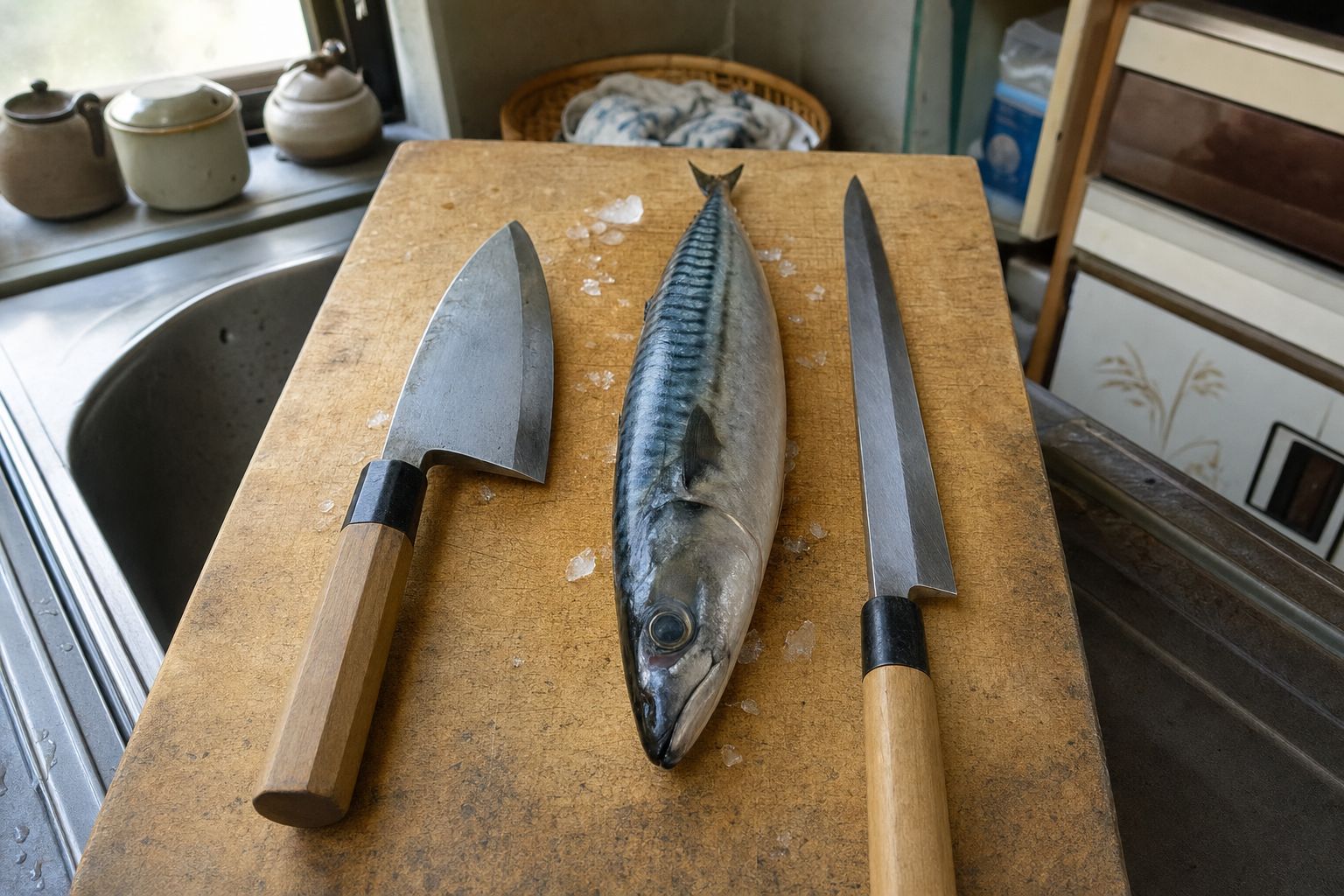
Right now, if you walk past the fish counter at a Japanese supermarket, you’ll find trays of whole saba and the last of this year’s sanma, priced to move before the weekend. Almost nobody buying them owns a yanagiba. That surprised me when I actually looked into it — the knife that shows up in nearly every “essential Japanese knives” roundup online is, in real Japanese kitchens, a professional’s tool that most home cooks never touch.
The short version: deba and yanagiba are both single-bevel knives built for raw fish — the deba for breaking a whole fish down, the yanagiba for slicing it into sashimi afterward. They’re real, specialized, often genuinely beautiful tools, and most home cooks, in Japan or anywhere else, don’t need either one. If you want the actual benefit without the single-bevel learning curve, a sujihiki — covered further down — covers most of what a home kitchen actually asks for.
What each knife is actually for
A deba is short and thick — usually 150mm to 240mm, heavy toward the spine, with a blade that tapers to a strong point rather than staying thin edge to edge. It’s built to take a whole fish apart: cut behind the gills, open the belly, lift the fillets off the bone, and if you need to, push through smaller bones with the heel of the blade rather than finesse around them. It’s closer in spirit to a nakiri than to a slicing knife — a tool for one decisive job, not a do-everything blade.
A yanagiba does the opposite job with the opposite shape: long, thin, and narrow, typically 210mm to 300mm or more, built only to slice. Once the fillet is off the bone, a yanagiba pulls through it in a single long stroke — not sawed back and forth the way a Western knife works a cut, but drawn once, cleanly, so the cut surface stays smooth instead of ragged. That single pull is most of why good sashimi looks the way it does. It has almost nothing to do with the fish being fresher; it’s the knife and the stroke.
Single-bevel is the part that actually matters
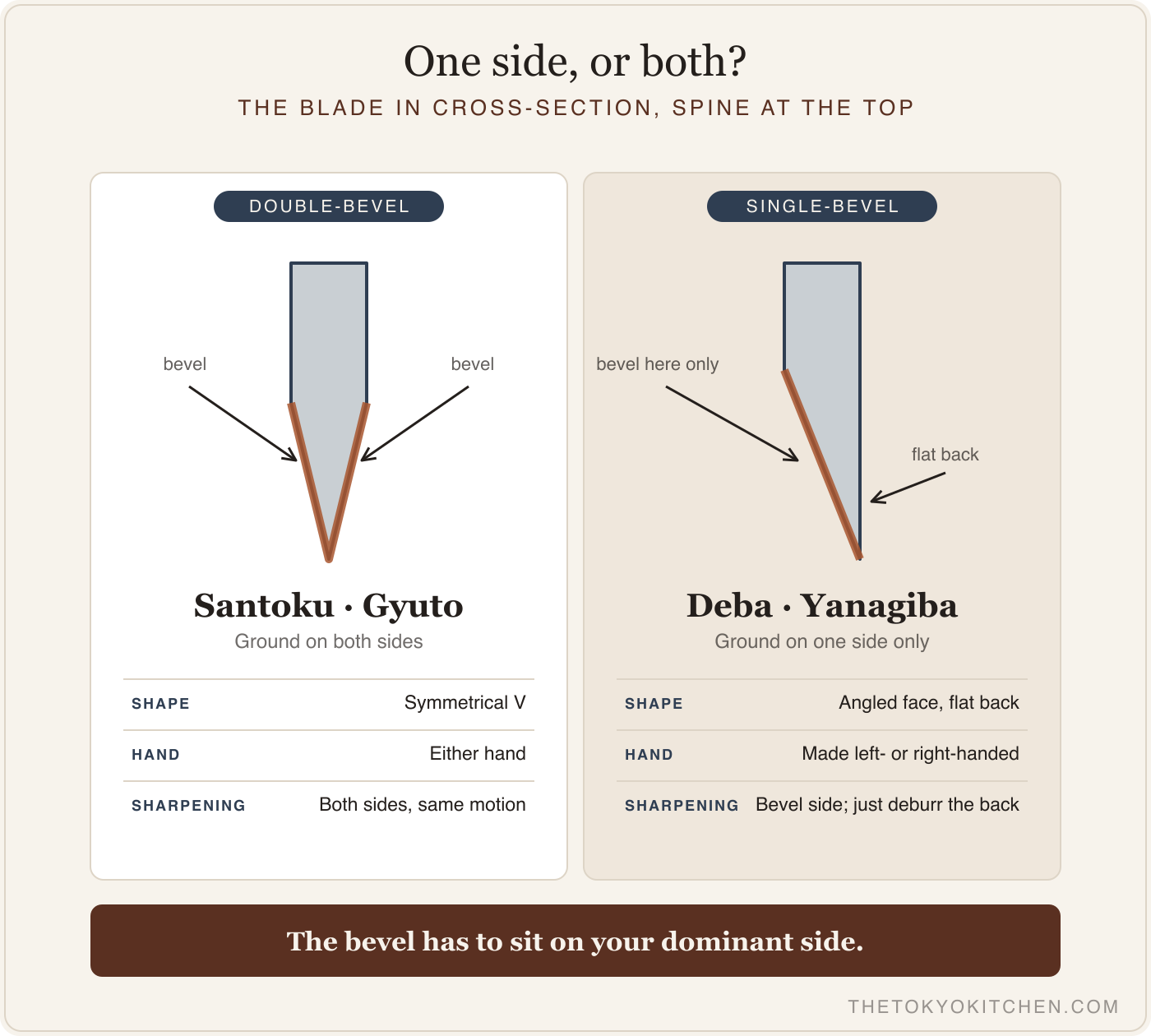
Your santoku and gyuto are double-bevel — ground on both sides, which is why they feel neutral in either hand and why sharpening one is the same motion no matter which side you’re working. A deba and a yanagiba are ground almost entirely on one side, with the back left nearly flat. That single bevel is what lets the blade pull a perfectly flat cut through soft fish instead of wedging and tearing it, and it’s also why these knives come in right-handed and left-handed versions — the bevel has to sit on your dominant side, or the knife actively fights you.
It also changes how you sharpen them. You work the beveled face through your stones, feel for a tiny burr forming on the flat back, then clean that burr off with almost no pressure at all instead of grinding a second bevel into it. Get that part wrong — and it’s an easy mistake the first few times — and you’ve turned a single-bevel knife into a crooked double-bevel one, which sharpens worse than either.
Where this actually happens in a Japanese kitchen
Here’s the part that doesn’t match the knife-roundup version of this story: most of the whole fish sold in Japan right now — saba heading into its best weeks, the tail end of sanma season before the fish get smaller and thinner — gets grilled whole, head and tail on, with grated daikon and a squeeze of citrus on the side. Nobody’s reaching for a deba to break it down first. Sanma, in particular, has had a rough run of seasons; catches have been shrinking for years, so a lot of what you see at the counter this time of year is smaller and scarcer than it used to be, and salt-grilling whole is simply less work and less waste than filleting.
Where deba and yanagiba actually live is behind the counter at a sushi restaurant, in the hands of someone who breaks down dozens of fish a week and has the repetition to keep a single-bevel edge honest. In Japanese, the whole process just has one plain verb — oroshi, おろす, the same word you’d use for grating a radish. That tells you something: taking a fish apart is just a kitchen task — there’s no ceremony to it.
I don’t own either knife myself, and I’m not in a hurry to fix that.
For most households, the tool for it is a fishmonger’s counter, not a drawer at home.
The double-bevel way around this
If what actually draws you to a yanagiba is the clean slice — the idea of cutting raw tuna or salmon at home without it looking torn — a sujihiki gets you there without the single-bevel learning curve. It’s a long, thin slicing knife like a yanagiba, but ground on both sides like your santoku or gyuto, so it sharpens the normal way and doesn’t care which hand you favor. It won’t take a whole fish apart the way a deba will, and a true yanagiba’s single bevel still pulls a marginally cleaner slice through delicate fish in skilled hands. But for slicing already-filleted fish, cured salmon, or a roast at the table, a sujihiki does the job a home cook actually has.
That’s the one opinion in this article I’ll state flatly: don’t let a yanagiba be the first “serious” Japanese knife you buy. Steel and sharpening questions are hard enough to learn on a double-bevel blade you already use daily. Learning them on a single-bevel knife you’ll pick up twice a year, for a cut you could get almost as clean with a sujihiki, is spending real money to make your life harder on purpose.
What this actually costs
Prices overlap far more than the mystique suggests. At Hocho Knife, at the time of writing, a stainless deba starts under $100 (a 150mm Masahiro is about $80), and white-steel ones from established makers like Masamoto run past $400. Yanagiba look much the same: stainless models from roughly $75 to $100, carbon-steel ones from the big names at $400 to $600 for the longer lengths. A sujihiki sits in that same band — about $55 for a basic stainless 240mm up to around $450 for carbon steel. So a sujihiki isn’t the cheap option. The difference is that it’s a knife you’ll actually keep using, because it sharpens like everything else in your drawer.
None of these are cheap, and none of them should be an impulse purchase. A deba or yanagiba is a tool you buy because you’ve already found yourself wanting one on a specific, recurring job — not because a listicle told you a “real” Japanese knife set needs one.
The honest recommendation
If you cook a whole fish from the market more than a couple of times a month and you’re tired of fighting it with a santoku, a deba earns its drawer space. If you genuinely want to slice sashimi at home the way a restaurant does, a yanagiba will get you there, with a few months of practice priced in. For everyone else — which, going by what actually ends up in Japanese home kitchens, is most people — a sujihiki covers the slicing itch, and the fishmonger covers the rest.
If you’re still working out which Japanese knife to buy before any of these, start with the first one — a deba and a yanagiba belong fourth or fifth in a drawer, long after this one.
— Sen
Want the short version?
The One-Knife Kitchen: how to choose and care for the single Japanese knife that replaces the block — free, printable, one page.
Send me the free guide →