Teaware
Kyusu: The Japanese Teapot That Explains Why Your Sencha Tastes Wrong
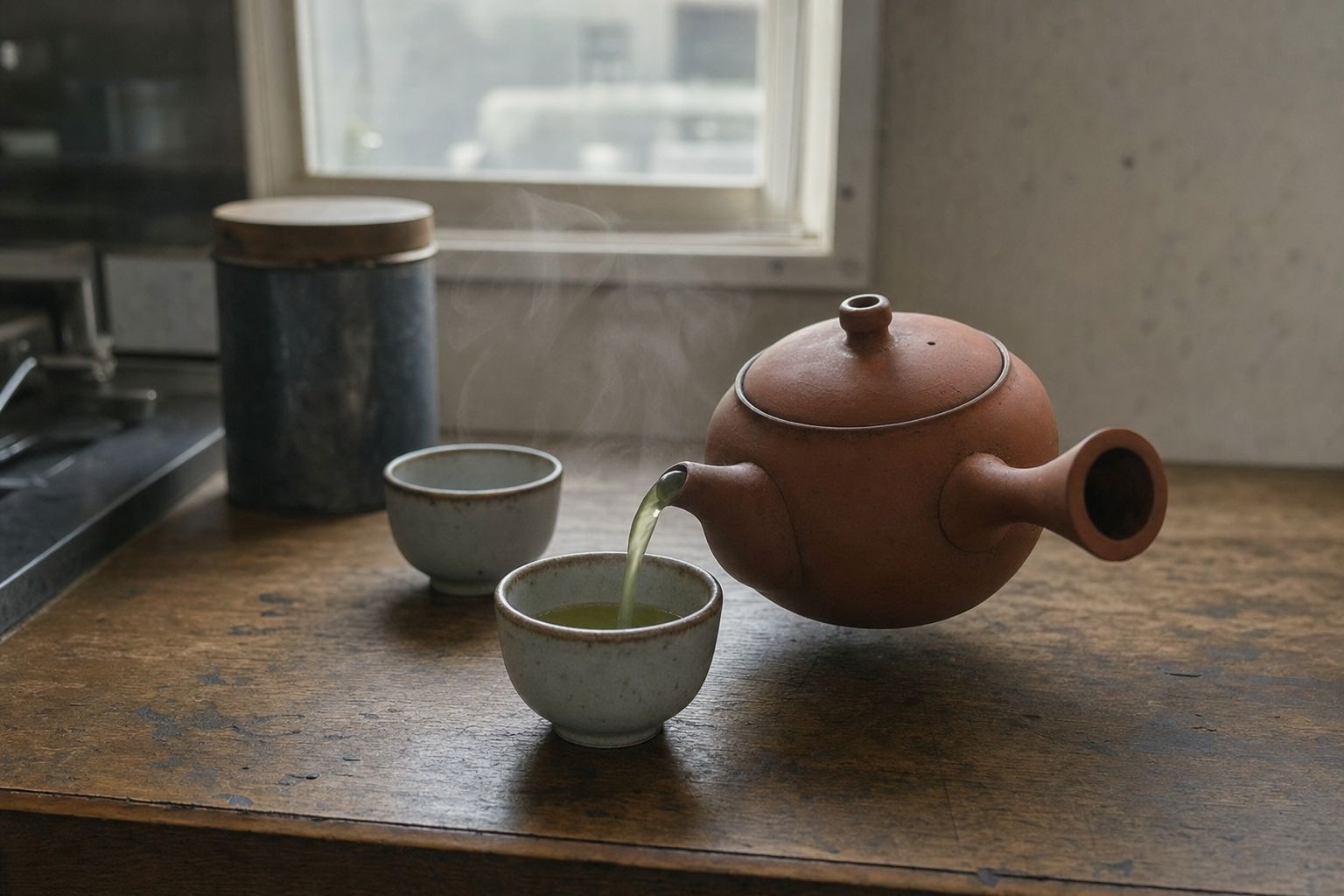
Search “Japanese teapot” abroad and you mostly get cast iron — black, heavy, sold in gift sets with two tiny cups. That’s not what makes tea in a Japanese kitchen. The everyday pot is small, made of clay, has a handle sticking out sideways instead of over the top, and most people who’ve bought a “Japanese-style” teapot online have never actually used one.
The short answer: the pot you want is called a kyusu (急須), it has a built-in ceramic or fine mesh strainer at the base of the spout, and the side handle isn’t decorative — it’s how you pour one-handed without scalding your wrist. If your teapot needs a separate metal infuser basket dropped inside it, it’s not really a kyusu, and that’s very likely part of why your loose-leaf green tea keeps coming out either weak or bitter.
The handle is the whole design
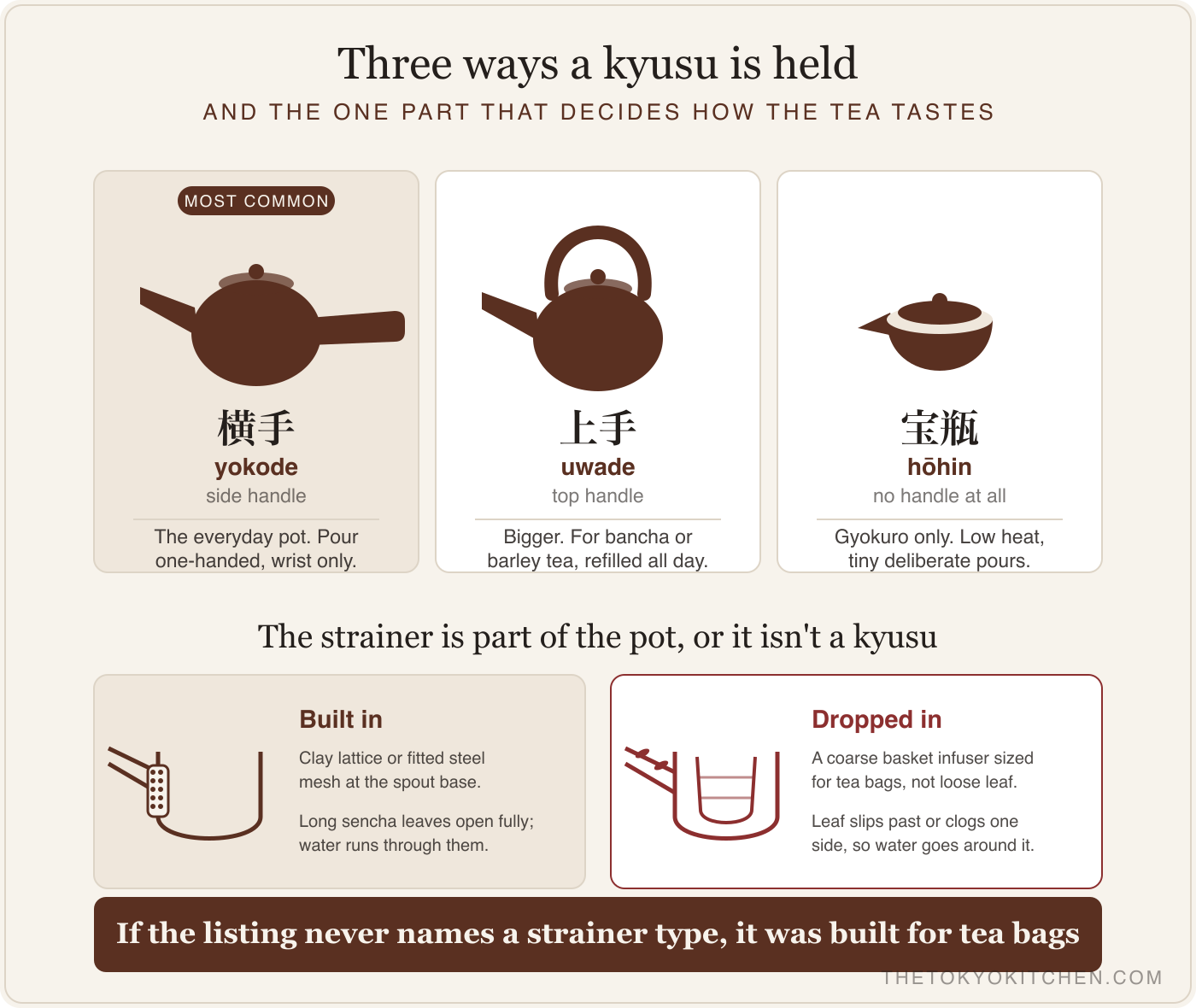
A kyusu is built around one working assumption: you’re pouring with one hand, probably while doing something else with the other. The handle — yokode (横手, “side hand”) — sits at roughly a right angle to the spout, so a light wrist rotation tips the whole pot forward. It sounds like a small thing until you’ve used one for a year and then picked up a Western teapot by its back handle, which suddenly feels like it requires two hands and a plan.
There are two other, rarer shapes worth knowing so you’re not confused when you see them. Uwade (上手) has a handle arched over the top, like a Western pot — you’ll see this on bigger pots meant for bancha or mugicha (barley tea) that get refilled all day rather than poured delicately. And hōhin (宝瓶) has no handle at all: a small lidded bowl-pot held by its body, used specifically for gyokuro, the shaded green tea that’s brewed at a low temperature and poured in tiny, deliberate amounts. If you’re shopping for a kyusu and see one with no handle described as premium, that’s why — it’s not a cheaper design, it’s a different job.
The part that actually matters: the strainer
Inside the base of the spout, a real kyusu has one of two strainer types built into the pot itself. Older and more traditional pots use a tōsei chakoshi (陶製茶こし) — a lattice of tiny holes carved directly into the clay wall where the spout meets the body. Newer ones use a stainless steel mesh insert that clips in, which does the same job and is much easier to clean.
Either way, the strainer is part of the pot, not an accessory you add. This is the detail that gets lost when a “Japanese teapot” gets manufactured for export: swap the built-in strainer for a coarse metal basket infuser, and full, unrolled sencha leaves — which are longer and finer than what most infuser baskets were designed around — slip straight through or clog the holes on one side, so the water channels around them instead of through them. You get a cup that’s either full of leaf fragments or strangely weak, and it’s not your technique.
It’s the pot.
I learned this the annoying way. A few years ago I bought what a home-goods import shop was calling a “Japanese-style teapot” — nice glaze, side handle even — and the infuser was a wide-gauge wire basket. Every pot of sencha came out thin, like it had been brewed for thirty seconds instead of ninety. I assumed I was buying bad tea. I wasn’t; I was using the wrong equipment for it, for about eight months, before someone in Japan asked to see it and just laughed.
Where they’re made, and what that changes
Two regions do most of the everyday kyusu production in Japan, and the clay itself changes how the tea tastes — not dramatically, but noticeably if you switch between them.
Tokoname (常滑焼), from a coastal town in Aichi Prefecture, is probably the most recognized kyusu style. The clay is naturally rich in iron oxide, and unglazed Tokoname ware is said to soften the bitterness and astringency of green tea slightly — a claim that goes back generations locally rather than one I can prove with a lab result, but it’s the reason serious sencha drinkers specifically seek out unglazed Tokoname pots over glazed ones.
Banko-yaki (萬古焼), from Yokkaichi in Mie Prefecture, makes the bulk of the mass-market kyusu you’ll find at a home center or supermarket here — the ¥1,500 to ¥3,000 pot that’s in a huge number of Japanese kitchens, including mine before I “upgraded.” Banko clay also runs high in iron content, and the same region’s earthenware is generally known in Japan for holding heat well — the same reputation that makes Yokkaichi responsible for roughly 80–90% of the donabe clay cooking pots made in the country, on top of all those teapots.
Above that everyday tier, hand-thrown pots from named Tokoname or Banko kilns run considerably higher — a shop-bought artisan piece can land anywhere from around ¥8,000 into five figures, and that’s before you’re anywhere near the collector end of the market.
A cheap one is not a mistake
My grandparents’ house always had a kyusu going. Nothing special — I don’t even know where they bought it — but tea made there tasted like actual tea in a way I didn’t have words for as a kid. Not the bagged, slightly flat stuff from a box; something rounder, with body to it. I didn’t understand why until years later, brewing sencha in my own kitchen with a proper pot and realizing the difference was never the tea leaves my grandparents bought. It was that a kyusu, at any price, lets loose leaf actually unfurl and steep the way it’s meant to.
So don’t let the artisan end of this market talk you out of starting. A ¥1,500 Banko-yaki pot from a home center does the real job. What you’re paying more for above that is glaze, shape, provenance, and a name on the box — not a fundamentally different cup of tea on day one.
Care, and the one habit that ruins them
Never use soap on the inside. Clay is porous, and detergent residue works into it the same way it would into unglazed cookware — a rinse with hot water right after use is the actual cleaning method, every time, and it’s also why the inside of a well-used kyusu darkens slightly over the years. That staining isn’t dirt. It’s patina, and collectors actually prize a well-seasoned interior — scrubbing it back to white would erase the thing they’re looking for.
The habit that actually ruins one is leaving wet tea leaves inside after you’re done. Empty the pot immediately, rinse, and leave it open to air-dry — the same two-second reflex I described for keeping a carbon steel knife from rusting applies here for a similar reason: it’s not the water itself, it’s water left sitting.
Buying one: what to actually check
- Size: most everyday kyusu run 200–300ml, good for two to three small cups. If you’re brewing for one, look for the smaller “hitori-yō” (一人用, “for one person”) size — closer to 120–150ml — rather than a full-size pot you’ll never fill.
- Strainer type: a built-in ceramic strainer is traditional and part of the pot forever; stainless mesh inserts are easier to clean and replace if damaged. Neither is wrong; it’s a maintenance trade-off rather than a quality difference.
- Unglazed vs. glazed: unglazed (usually Tokoname) if you’re brewing sencha or gyokuro and want the clay’s effect on flavor; glazed if you mainly want something practical and easy to wipe down.
- Skip anything described only as “Japanese-style” without naming a strainer type. That’s the export-market red flag from earlier in this piece, and it’s the single fastest way to end up brewing loose-leaf tea in a pot built for tea bags.
So, which one
If you already went through the knife brand breakdown on this site, this is the same advice in a different aisle: buy for the job, not the story. A ¥1,500–¥3,000 Banko-yaki kyusu with a stainless mesh insert covers real daily use. Move up to unglazed Tokoname once you know you’re actually drinking enough loose-leaf tea to notice the difference — the same logic I’d give anyone standing in front of the cutting board wall trying to decide whether they need the expensive option on day one.
Mine sits on the counter next to the stove, used most mornings, wiped and left open to dry every single time. It’s not the hand-thrown one from the pottery town I keep meaning to visit. It’s a Banko-yaki pot from a home center, and it makes tea that tastes like the version I grew up drinking at my grandparents’ place — which, it turns out, was never about the price of the pot at all.
— Sen
Want the short version?
The One-Knife Kitchen: how to choose and care for the single Japanese knife that replaces the block — free, printable, one page.
Send me the free guide →