Knives
Sujihiki, Explained: Japan's Slicing Knife for the One Big Roast You Carve All Year
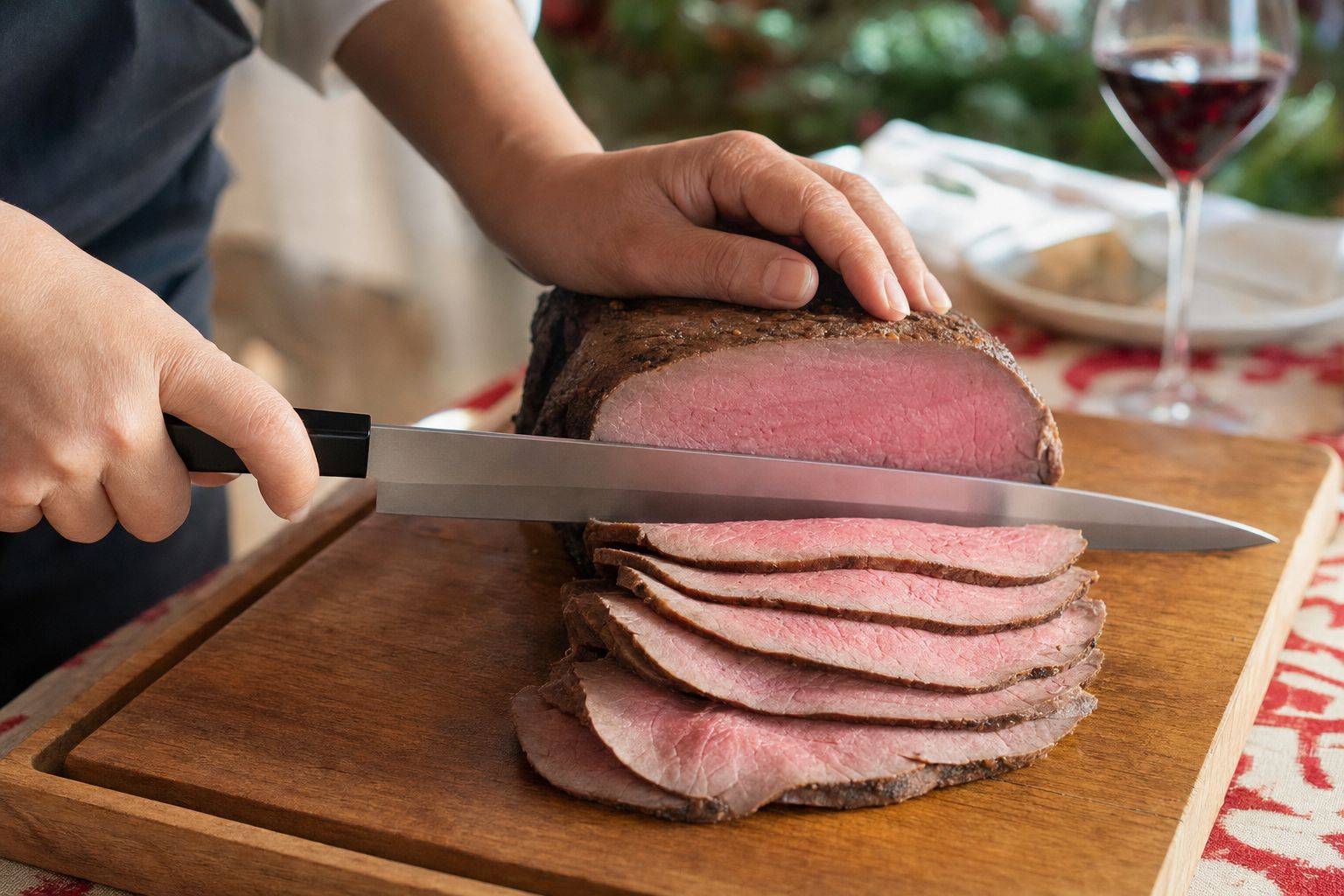
Right now, Japanese department store food floors are starting to put up the signs for the season’s roast beef and ham sets — the ones that get ordered in November for pickup in late December. Every one of those sets arrives whole. Nobody delivers it pre-sliced, because pre-sliced roast beef sitting in a box for two weeks is not a good roast beef. Whoever hosts is going to be standing at a cutting board with a knife, and most people’s knife for that job is wrong.
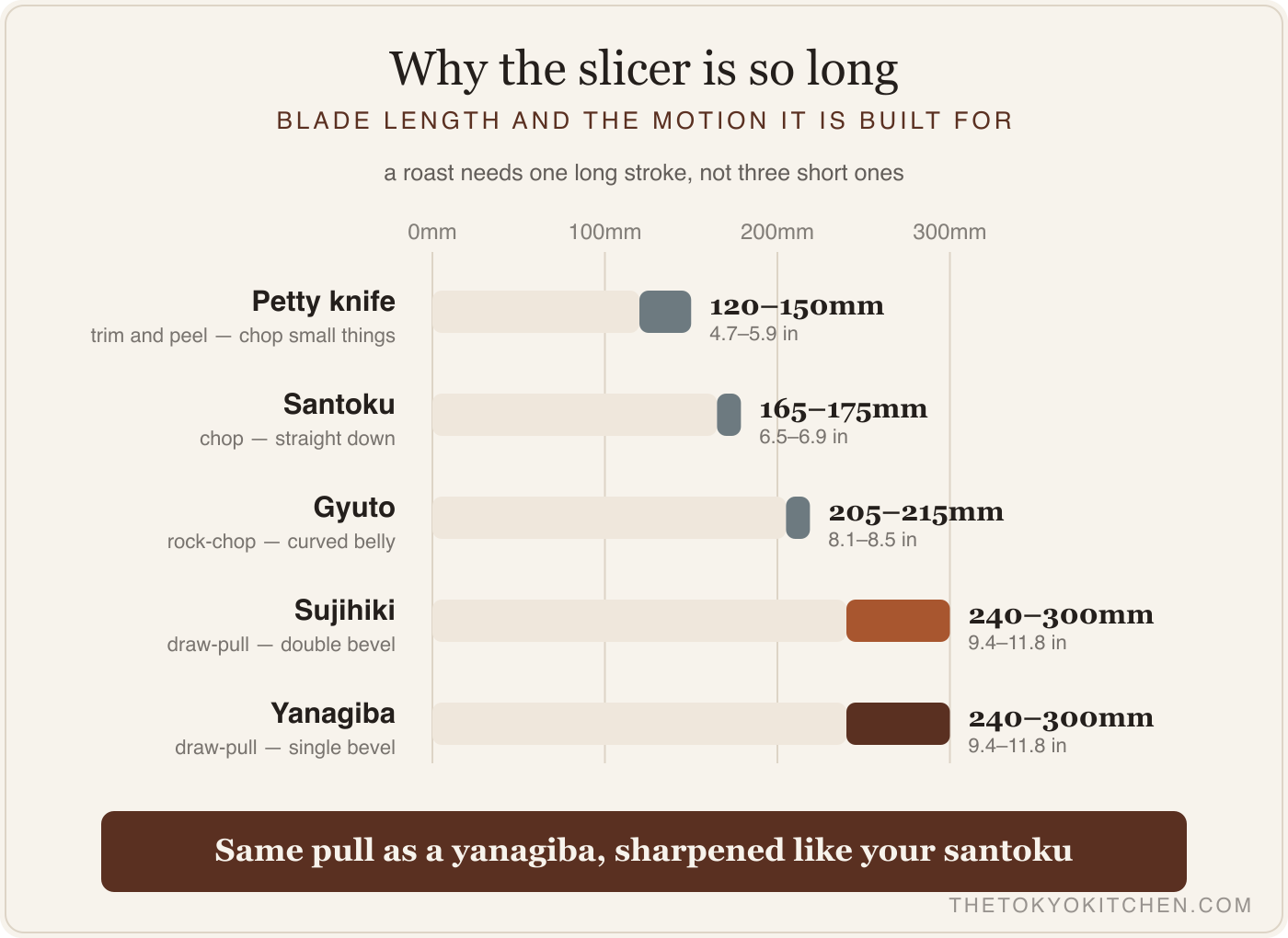
The short version: a sujihiki is a long, thin, double-bevel slicing knife — usually 240mm to 300mm — built to pull through a cooked or cured protein in one smooth stroke instead of sawing it into ragged pieces. It’s the practical cousin of the single-bevel yanagiba, sharpens like any other knife in your drawer, and it earns its keep almost entirely around the one or two meals a year where you’re actually carving something.
What the name is telling you
Sujihiki is written 筋引き — suji (筋), sinew or muscle fiber, plus hiki (引き), to pull or draw. Put together, it’s roughly “the knife that pulls through muscle,” which is a more honest name than most knife marketing bothers with. It’s not describing a shape so much as a motion: you don’t push down and saw, you lay the full length of the blade against the meat and draw it through in one pass, letting the edge do the separating instead of forcing the fibers apart.
That motion is the whole point. A serrated Western carving knife — the kind that comes in a lot of starter block sets — works by tearing, which is fine on bread and genuinely bad on a tender roast; you get a ragged edge and a plate full of meat juice instead of clean slices. A sujihiki does the opposite: it compresses almost nothing on the way through, so the slice keeps its shape and the cut surface stays smooth enough to look intentional on a plate.
Sujihiki vs. yanagiba: same job, different maintenance
The yanagiba does this same long, single-pull slicing motion, and does it slightly better on delicate raw fish — but it’s single-bevel, ground almost flat on one side, which means it comes in handed versions and needs a specific sharpening technique to avoid turning a precise blade into a crooked one. A sujihiki is ground on both sides like your everyday santoku or gyuto, so it doesn’t care which hand you favor and it sharpens with the same motion you already use on the rest of your knives.
That’s the trade worth understanding: a yanagiba, in skilled hands, pulls a marginally cleaner cut through sashimi-grade fish. A sujihiki gets you most of that same clean slice on cooked and cured proteins — roast beef, ham, smoked salmon, a whole chicken or turkey — without asking you to learn a second sharpening method for a knife you might use four times a year. For nearly everyone reading a guide like this instead of working a sushi counter, that’s the right end of the trade.
Why your gyuto and santoku don’t really do this job
A gyuto has a curved belly built for rock-chopping — it’s the right shape for mincing garlic, wrong for a straight pull through a large piece of meat, because the curve wants to rock rather than draw. A santoku is even shorter and flatter, fine for vegetables and weeknight proteins, but too short to get through a roast in one stroke; you end up sawing in two or three bites, which is exactly the ragged result a sujihiki avoids. And a petty knife — the small one that handles fruit and trimming — is simply too short for anything bigger than a chicken breast.
None of those knives are wrong for what they’re built for. They’re just not built for this one task, and a roast is unforgiving about that in a way weeknight cooking usually isn’t.
Where this actually shows up in a Japanese kitchen
Here’s the part that doesn’t come up in most knife-shopping guides: in Japan, a sujihiki isn’t really marketed as a “fancy knife for enthusiasts.” It shows up at the exact moment a household decides to make or serve a whole roast — which, for most families, is a handful of times a year clustered around bōnenkai (the year-end gatherings that start filling up calendars right about now) and New Year’s. Department store food floors sell whole roast beef and ham blocks specifically for this stretch, priced for gifting — a roast beef set supervised by a restaurant chef, sauce included, runs roughly ¥5,400 at a store like Takashimaya, and that’s a mid-range example, not the top of the range. Buy one of those whole, and you’re the one holding the knife.
It’s the same instinct behind the home-roast-beef trend that’s been building for a few years now: people buying a plain beef block — often imported, often from a membership warehouse club — searing it, and slow-roasting it themselves instead of paying department-store prices. Either way, somebody ends up slicing a warm or cold roast into even pieces for a table of people watching, and a dull chef’s knife or a serrated bread knife turns that moment into visibly torn meat.
I don’t own a sujihiki myself. The knives in my own kitchen stop at about four, which is roughly what most Japanese households have — and none of those four is shaped for this job, which is exactly why the roast ends up meeting whatever’s sharp and long.
Nobody plans for this. It just happens the first time someone’s holding a whole roast and a dinner knife.
What it costs, and the one opinion I’ll state flatly
At Hocho Knife, at the time of writing, sujihiki prices run from around $120 for an entry-level stainless blade in the 200–240mm range up toward $1,000-plus for a damascus-finished one from a name maker — a mid-tier stainless 240–270mm usually lands somewhere between $160 and $270, which is comparable to a solid first santoku or gyuto rather than a luxury purchase on top of one. The site ships from Japan, so if you’re already ordering a whetstone or a main knife from the same specialist, it’s worth adding to that box instead of paying shipping twice.
The opinion: don’t buy a serrated “carving knife” as your answer to this, Japanese or Western. The serration feels like it should help with a tough roast, and it does the opposite — it tears the surface instead of slicing it, and it’s miserable to sharpen when it eventually dulls. A plain, long, sharp edge beats a serrated one on every protein you’re likely to carve at home.
The honest recommendation
If carving happens at your table more than two or three times a year — a holiday roast, a ham, slicing cold cuts for sandwiches the next day — a sujihiki is one of the more justifiable “extra” knives you can add, because it does a job your main knife genuinely struggles with, not a job it merely prefers. If carving at your table means pulling apart a rotisserie chicken from the supermarket with your hands, which is a completely normal way to eat a rotisserie chicken, skip it. The knife doesn’t improve a meal nobody’s slicing in the first place.
Steel and sharpening questions work the same here as everywhere else in your knife drawer — stainless if you want to not think about it, carbon if you don’t mind drying it by hand. The only thing that’s actually different about a sujihiki is the shape, and the shape is the entire reason it exists: long enough, thin enough, and sharp enough to let one roast a year look like it was carved on purpose.
— Sen
Want the short version?
The One-Knife Kitchen: how to choose and care for the single Japanese knife that replaces the block — free, printable, one page.
Get the free guide →