Kitchen Tools
Tamagoyaki Pan, Explained: The Rectangular Egg Pan That Gives Away Where You're From
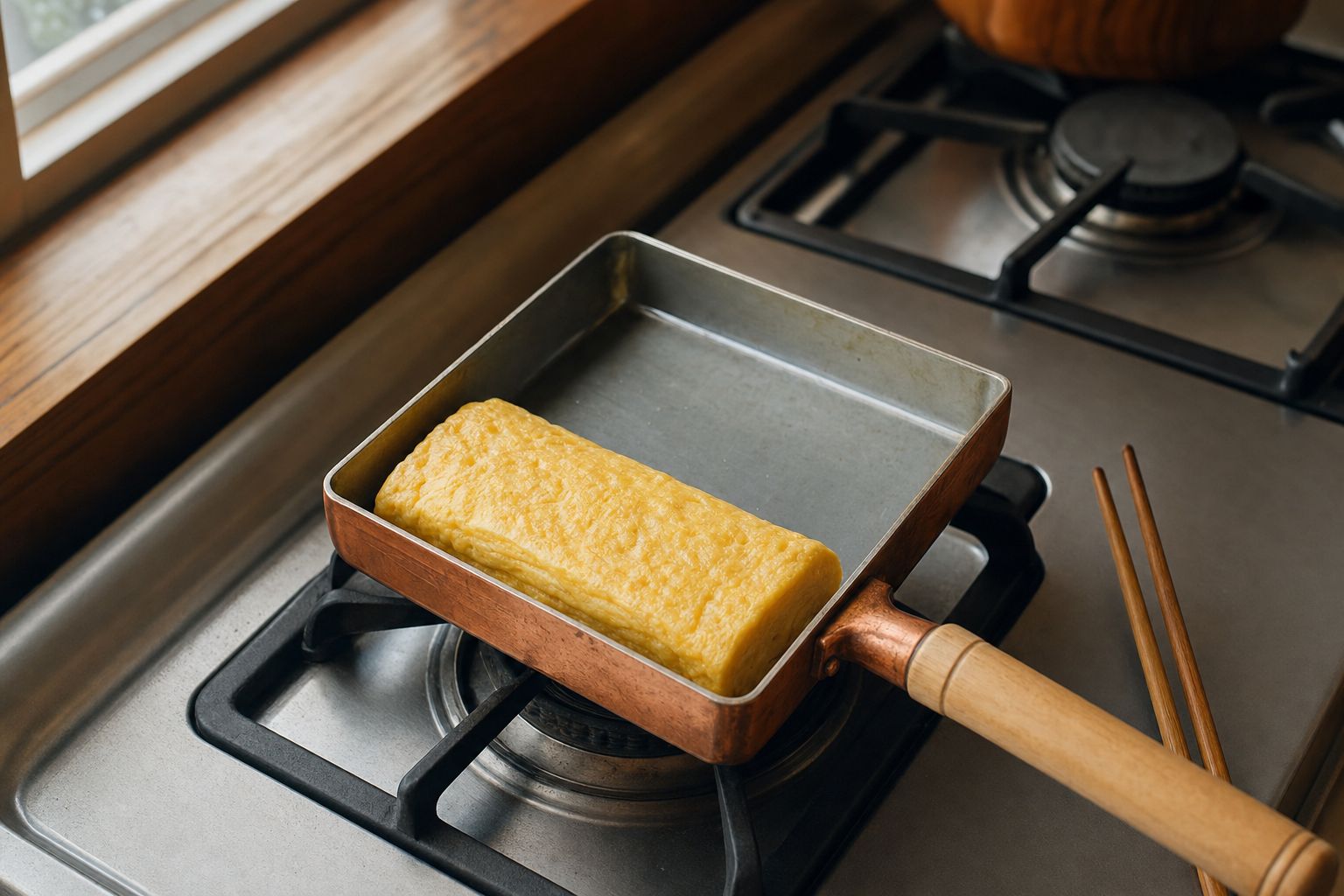
Open the cupboard in almost any Japanese kitchen and you’ll find a pan that doesn’t look like it belongs with the others: small, rectangular, flat-bottomed, with nothing round about it.
It only does one job.
In most Western kitchens that would be a dealbreaker for a pan taking up drawer space. In Japan it’s the opposite — the job is common enough, and specific enough, that the single-purpose pan won.
The short version: a tamagoyaki pan is a small rectangular pan built to roll Japanese omelette into a neat log instead of a flat disc, and its exact shape — nearly square versus a narrow rectangle — tracks the same east-west line that splits Japan’s two tamagoyaki styles. Buy the shape that matches the style you actually want to cook, not the other way around.
What the pan is actually doing
A round skillet makes a round or oval omelette. A tamagoyaki pan is rectangular on purpose, so that every layer of egg you pour in and roll stays the same width from one end to the other. Cook a thin sheet, roll it to one side, pour the next thin sheet into the space you just cleared, roll again — the result is a tidy, even bar of egg rather than a lumpy fold. You then slice it crosswise into bento-ready rectangles. Try this in a round pan and the rolled log tapers at the edges instead of staying square; it still tastes fine, it just won’t stack or slice the way a tamagoyaki should.
The pan itself is called a makiyaki-nabe (roughly, “rolling-grill pot”); tamagoyaki is the name of the dish that comes out of it, the way “wok” and “stir-fry” aren’t the same word even though one only exists for the other.
Two shapes, two very different omelettes
Here’s the part that surprises people who’ve only ever seen one version of this pan online: there isn’t one standard shape. Dedicated kitchenware shops sell at least two, under names tied directly to region.
- Kanto-style (eastern Japan, Tokyo included): close to a true square — common household sizes run roughly 12×12cm for a one- or two-egg batch up to about 15×15 or 18×18cm for a bigger one. This shape is built for atsuyaki tamago, the thicker, sweeter version: more egg poured per layer, fewer rolls, a firmer result built to hold up in a bento box for hours.
- Kansai-style (western Japan, Osaka and Kyoto included): a noticeably narrow rectangle — figures from copper-pan makers run around 10.5×15cm. That shape is built for dashimaki tamago: thin layers, lots of rolls, a loose, custardy egg held together with dashi stock rather than sugar.
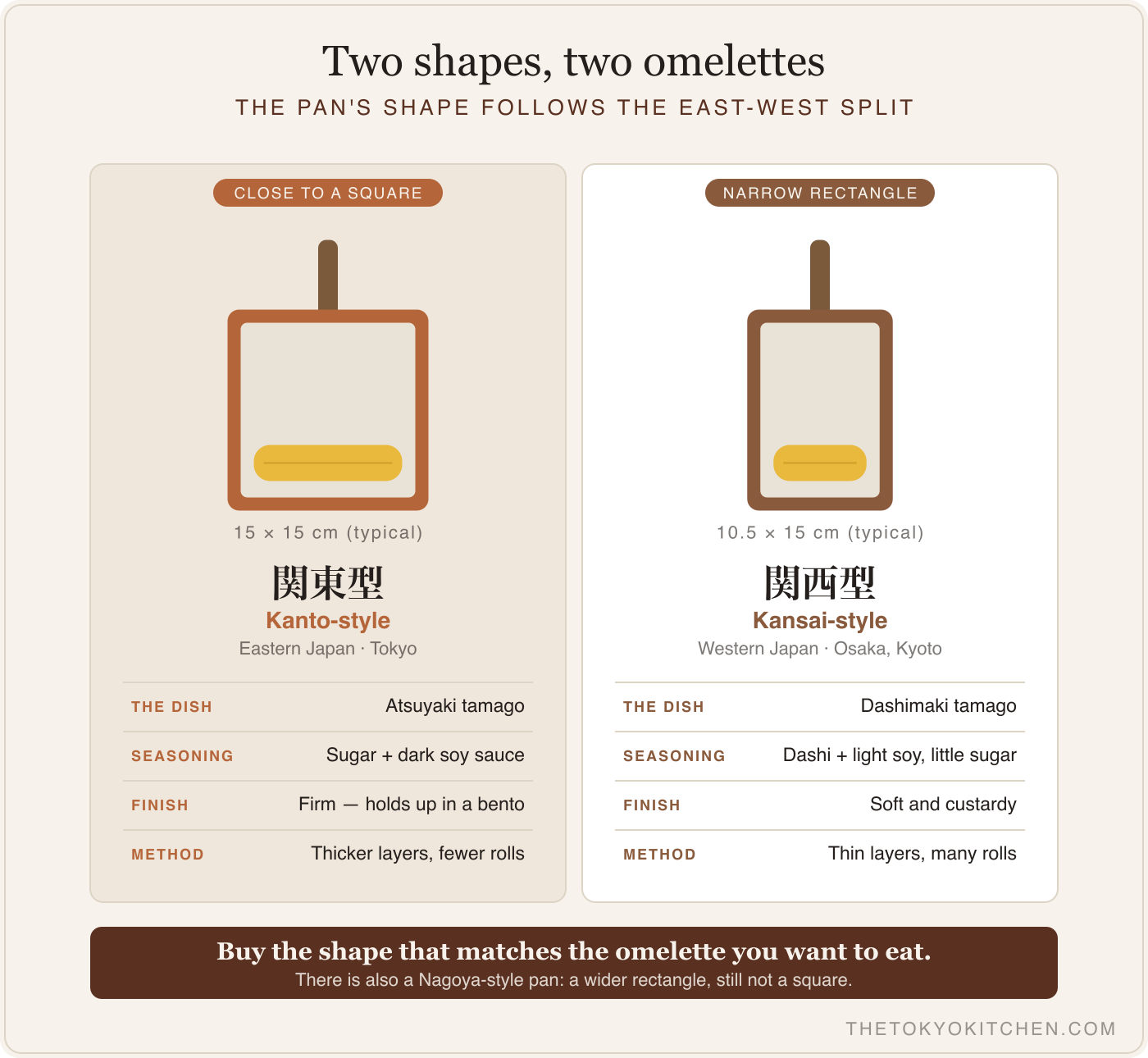
There’s a third regional variant, Nagoya-style, wider than the Kansai pan but still a rectangle rather than a square — a reminder that this isn’t really a two-way split so much as a shape that quietly tracks a whole map of local cooking habits most people never think to ask about.
The flavor divide maps almost exactly onto the shape divide. Kanto-style tamagoyaki goes in with sugar and a dark soy sauce, baked firm enough to survive sitting in a lunchbox since 7am. Kansai-style dashimaki skips the sugar almost entirely, leans on dashi and a lighter soy, and comes out soft enough that you’d struggle to pack it without it falling apart. Same egg. Same rough idea of “roll it.” Completely different pan and completely different dish depending on which side of the east-west line you grew up on.
Where I actually landed on this
I grew up in Gunma, which puts me squarely on the Kanto, sweet-and-firm side of that line, and my mother’s version was non-negotiable: sweet tamagoyaki, next to fried chicken, a wedge of potato, a sausage, spinach sautéed in butter, carrot, and whatever frozen side had space left in the box. I liked the frozen stuff too, if I’m honest — nobody in my house treated it as a lesser ingredient.
My wife is from Tango, on the Kyoto side of the prefecture, and the first time I had her family’s egg course, I remember being thrown by how little it tasted like what I grew up calling the same dish. No sweetness. Soft almost to the point of falling apart on the chopsticks. It wasn’t bad — it was just not what the word “tamagoyaki” meant in my head until that point. Marrying into a Kansai-leaning food household turned out to be a slow education in exactly how much of what I’d assumed was universal “Japanese food” was actually just Kanto food with better marketing. How differently the two families make New Year’s mochi soup is its own story for another time.
Copper, iron, or nonstick
Material matters here more than it does for a generalist frying pan, because this one pan gets used almost daily for a very specific, fussy job: thin layers of egg that need to set fast without sticking.
Copper is what professional cooks reach for, and the sixth-generation owner of Iidaya — a long-running kitchenware shop in Tokyo’s Kappabashi district, the city’s wholesale kitchen-tool street — has said as much to the press: copper conducts heat so efficiently that the egg sets before too much moisture has a chance to evaporate out of it, which is a real part of why a professionally made tamagoyaki comes out so much softer than a home one. The honest tradeoff is that bare copper needs a tin lining to stop it corroding against egg and salt, and it benefits from the same kind of ongoing seasoning habit as a carbon-steel knife you keep dry and oiled rather than letting sit wet — not difficult, just a habit you have to actually keep. Over years of that care the copper surface darkens and takes on what Japanese craftsmen call aji — literally “flavor,” the character a well-used material develops that a brand-new one doesn’t have yet. A small copper pan from a specialist maker in Kappabashi runs roughly ¥7,000–8,000.
Iron is the heavy, durable option — traditional Nanbu-tekki cast iron versions included — and it seasons the same way a donabe clay pot does: slowly, with oil and heat, building a surface that gets better instead of worse with use. It’s also genuinely heavy for something you’re meant to pick up and tilt constantly while cooking.
Fluororesin-coated (nonstick) aluminum is what most Japanese households actually keep in the drawer day to day, and it’s the one I’d tell a first-time buyer to start with. A decent one runs around ¥3,000, it needs zero seasoning, and it forgives the mistakes — a slightly too-hot pan, a layer that sticks for a second — that turn a beginner’s first few attempts on copper into a frustrating mess instead of a lesson. The honest downside: the coating wears down after a couple of years of daily use, and once it starts to scratch, that pan is done. You’re not maintaining it forever. You’re replacing it eventually, and that’s fine.
My own opinion, for what it’s worth: skip pure copper as a first purchase unless you already keep a carbon-steel pan seasoned and dry without being told to. Buy the nonstick version in the shape that matches the omelette you actually want to eat, use it for a year, and only then decide if you’re someone who wants to deal with copper’s upkeep for a softer result.
Buying one outside Japan
If you’re shopping for a tamagoyaki pan online, check two things before anything else: the interior dimensions (a true Kanto square versus a Kansai narrow rectangle changes what the pan is actually good at) and whether it’s described as needing seasoning before first use, which most copper and bare iron ones do. A pan labeled simply “Japanese omelette pan” without a shape or material called out is usually a generic import rather than either regional style — not wrong to buy, just not the specific tool this guide is about.
Once you’ve got the pan, the rest of the setup is nearly free: long cooking chopsticks for rolling, a bowl, and whatever knife you’re already using to prep everything else going in the bento around it. It’s a small, cheap, oddly specific tool to add to a kitchen — and once you’ve used the right-shaped one for the dish you actually grew up eating, a round skillet feels like the wrong tool for the job in a way that’s hard to go back from.
— Sen
Want the short version?
The One-Knife Kitchen: how to choose and care for the single Japanese knife that replaces the block — free, printable, one page.
Send me the free guide →