Kitchen Tools
Donabe: The Japanese Clay Pot Behind Real Nabe (and Why Your Dutch Oven Can't Replace It)
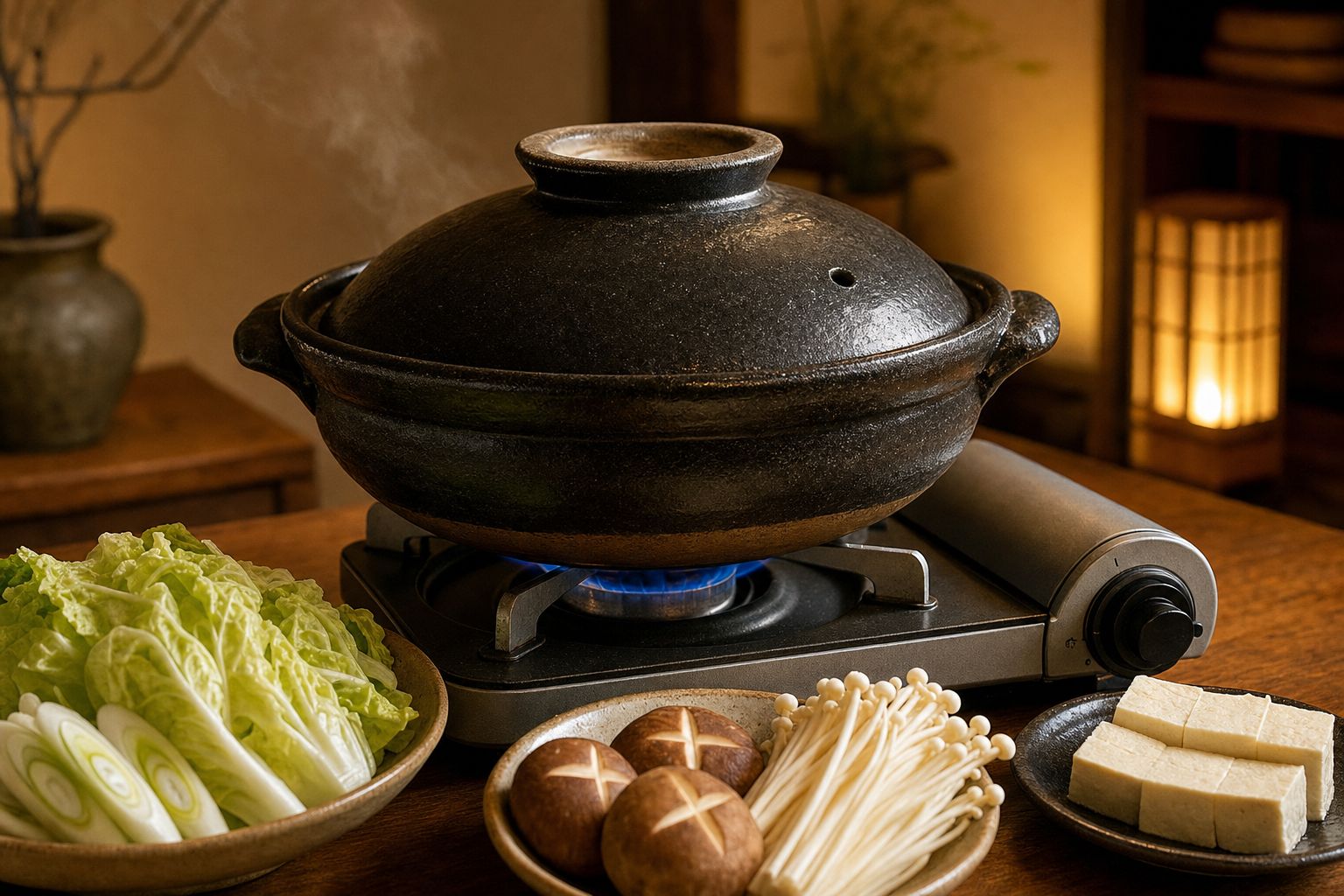
A donabe looks, at a glance, like a rustic cousin of the enameled Dutch oven already sitting in your cabinet. Round, heavy-lidded, built for slow cooking at the table. Treat it like one, though, and you will crack it — maybe not the first time, but eventually, on the night you’re in a hurry and set it straight onto a high flame while it’s still cold and dry.
That’s not a design flaw. It’s a different object doing a different job, made from clay that was never meant to survive the abuse a piece of cast iron shrugs off without comment.
The short answer: a donabe is an unglazed (or partly glazed) Japanese clay pot, fired from one of two clay traditions — porous, heat-retentive Iga-yaki or denser, flame-tougher Banko-yaki — and built specifically for nabe hot pot and stovetop rice, usually right at the table on a portable burner. It heats slowly, holds that heat long after the flame is off, and needs a short seasoning ritual before its first use. An enameled Dutch oven is more forgiving and better at searing, but it can’t replicate what a donabe actually does to rice and broth, and it’s roughly twice the weight for the same size. Below: which clay does what, how not to crack one, and where the money actually goes.
Two clays, one word
“Donabe” isn’t a brand or a single kiln — it’s a category, and almost everything sold under that name in Japan comes from one of two regions with genuinely different clay.
Iga-yaki comes from Iga, in Mie Prefecture, where the local clay was once the bed of ancient Lake Biwa roughly four million years ago. That sediment is dense with fossilized plant matter, and when it’s fired, the organic material burns away and leaves behind a body full of microscopic pockets — potters there call it “clay that breathes.” The result heats slowly and unevenly at first, then holds an enormous amount of heat once it’s warmed through, which is exactly what you want for something like a rice cooker that needs to hold steady, gentle heat for twenty minutes without anyone touching the dial. Iga-yaki pottery itself goes back about 1,200 years.
Banko-yaki, made around Yokkaichi in the same prefecture, uses a denser, more engineered clay body that accounts for roughly 80% of all donabe produced in Japan today — the everyday nabe pot in most Japanese households is Banko ware, not Iga. It’s thinner-walled, lighter, heats faster, and tolerates direct flame and sudden temperature swings noticeably better than Iga clay does. If Iga-yaki is the specialist built for one job — holding heat — Banko-yaki is the generalist built to survive a normal kitchen.
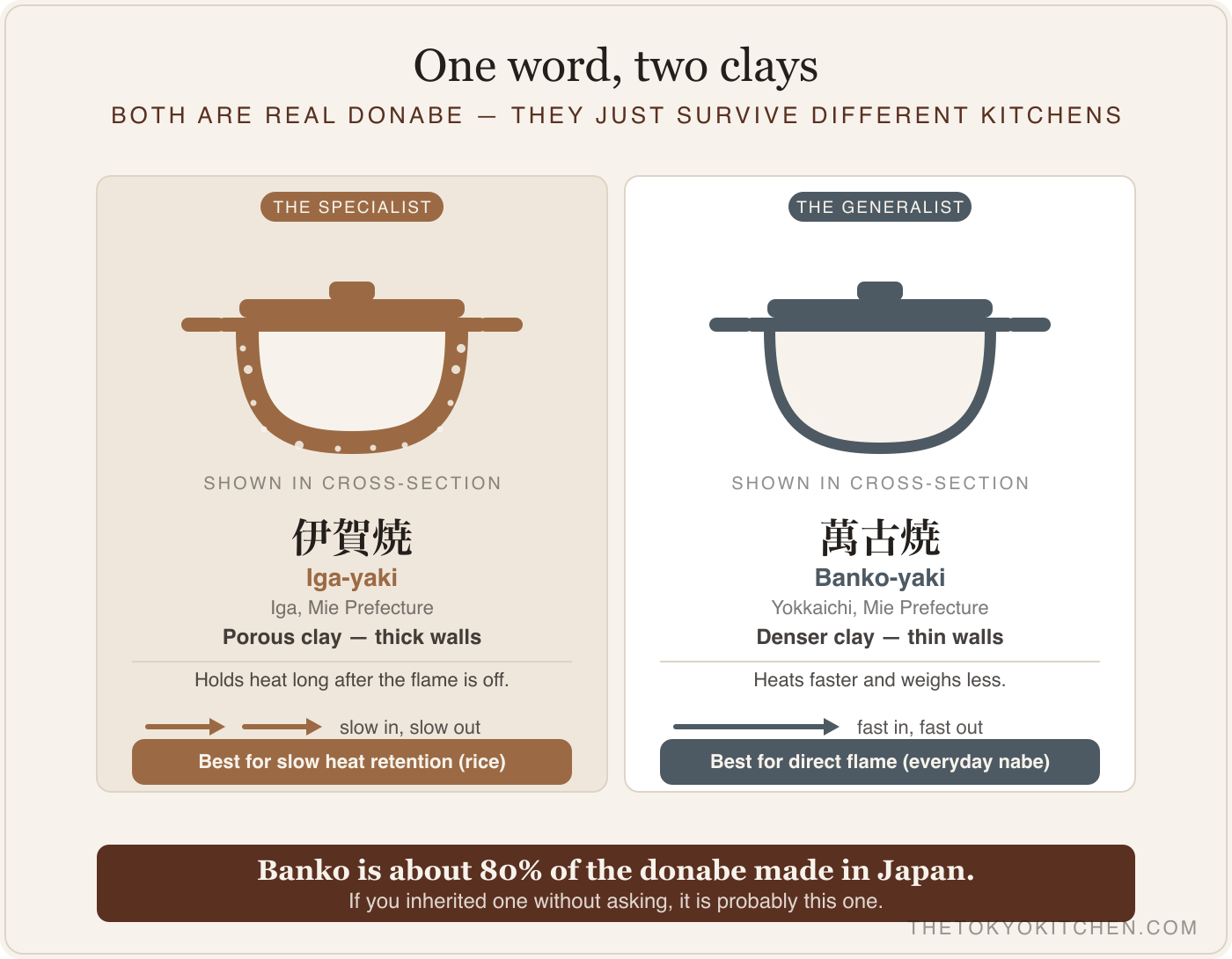
Neither one is “the real donabe” and the other a knockoff. They’re two answers to the same regional problem, and most kitchens in Japan end up with at least one of each without anyone explaining the difference — you just inherit whichever one your mother-in-law hands down.
Why it isn’t a small Dutch oven
Here’s the part the enameled cookware aisle doesn’t prepare you for: a donabe’s whole personality comes from clay that’s porous enough to breathe, and a Dutch oven’s enamel coating exists specifically to seal that kind of porosity away.
That difference shows up twice. First, in what it does to food — the slow, gentle, uneven heat of a donabe is why rice cooked in one comes out with a texture people who’ve had both describe as noticeably different from an electric cooker’s, and why broth simmered for hours in one doesn’t scorch the way it can in a thinner metal pot over a wandering flame. Second, in what it can survive. An enameled Dutch oven can go from a cold fridge shelf straight onto a hot burner without complaint. A donabe, especially an Iga-yaki one, cannot. Sudden temperature change is the single fastest way to crack it, which is why every donabe instruction sheet says the same unglamorous thing: start on low heat, add liquid before you add flame, and never let it boil dry.
None of this makes the donabe the better pot. A Dutch oven sears meat properly, survives a dishwasher cycle, and will outlive you. A donabe won’t do either of the first two things well, and if you drop it, it’s just gone — no repair shop fixes a shattered clay pot the way you’d re-season a chipped enamel one. Buy a donabe for what only it does, not to replace the pot that’s already earning its shelf space.
The ritual that keeps it from cracking
Before a new donabe touches real food, it needs medome (目止め) — literally “sealing the pores,” a one-time process that fills the clay’s microscopic gaps before they can fill with grease and odor instead. You bring the pot to a simmer with leftover rice-rinsing water — the cloudy water from washing rice before cooking it, not clean water — filled to about 80% capacity, hold it at a low simmer for around fifteen minutes, then let it cool fully before rinsing, drying, and putting it away.
It’s a fifteen-minute chore that most people skip on the first night because they’re hungry and the box says the pot is ready to use. Skip it and the donabe will still cook dinner fine. It’s just more likely to develop hairline cracks earlier, and more likely to hold onto smells from whatever strong-flavored broth you make first.
Day to day, the rules are shorter than they sound: don’t leave it soaking, don’t put it away even slightly damp, and let it air-dry fully — ideally overnight — before it goes back in the cabinet. A donabe stored wet is how you get a musty pot nobody wants to cook in by winter.
What I actually do
My wife’s family is from a fishing town on the Tango peninsula, on the Kyoto side of the coast most tourists never see because everyone’s headed for the temples further inland. Every winter we visit, the extended family ends up around one low table with a single donabe going at the center on a portable gas burner, and everyone just adds their own vegetables and fish to the same simmering broth as the night goes on. Nobody owns a small one. It’s one pot, sized for however many people show up that year, and it’s been replaced at least once in the years I’ve known the family — someone cracked the last one starting it cold on too high a flame, which is a mistake I now specifically watch for in my own kitchen.
I don’t cook rice in a donabe myself. My galley kitchen in Tokyo has one electric rice cooker doing that job every single day, and I’m not trading a machine I can start and walk away from for a pot that wants my attention on the stove. But hot pot is a different question entirely — for that, the donabe going straight from stove to table, staying hot through a two-hour dinner without a reheat, is doing something my everyday pots simply can’t.
Where donabe pots actually land, price-wise
Everyday Banko-yaki nabe pots sized for three or four people are the cheapest entry point, and they’re genuinely fine for regular hot pot nights — don’t spend more chasing a fancier glaze or a decorative seasonal pattern; the paint job doesn’t change how the pot cooks. Iga-yaki, and anything purpose-built as a rice cooker, sits a tier up.
| Type | Example | Weight (3–4 person size) | Who it’s for |
|---|---|---|---|
| Everyday Banko-yaki nabe pot | Generic Yokkaichi-made hot pot donabe | Roughly 4.5–6 lbs | Weekly hot pot, a first donabe |
| Iga-yaki rice cooker | Nagatani-en Kamado-san (3-go / ACT-01) | Similar range, thicker walls | Rice as a regular side, not just special occasions |
| Comparison point | Le Creuset 5.5-qt round Dutch oven | 11.5 lbs | The pot most people already own instead |
The Nagatani-en Kamado-san — the closest thing the category has to a household-name product outside Japan — runs about $110 (¥16,500) for the standard 3-go size, roughly the amount most couples eat in a week. It’s slower than an electric rice cooker and needs you to actually watch the clock instead of pressing a button, which is the honest tradeoff for rice that a lot of people who’ve used both say tastes noticeably better.
The honest recommendation
Don’t buy a donabe to replace the pot you already reach for most nights. Buy the cheap Banko-yaki one if hot pot is a real, recurring thing in your house and you’re tired of your soup pot losing heat the moment you take it off the burner — that’s the whole use case, and it’s a modest purchase. Buy the Iga-yaki rice cooker only if you already eat enough rice, often enough, that the extra fifteen minutes of attention is worth it to you; if rice is an occasional side dish, it isn’t.
What it isn’t, either way, is a Dutch oven with better branding. It’s a lighter, more specialized, more breakable tool built around clay that does one specific thing — hold and release heat slowly — better than anything with a metal core ever will, and worse at almost everything else. The knife you use to prep everything that goes into it will outlast three donabe pots. The kettle that boils the water for tea afterward is unglazed cast iron for a similar reason — different metal, same idea: bare material in direct contact with what you’re heating, on purpose. And if the whole conversation makes you want the everyday clay teapot version of this same philosophy, that’s a separate guide worth reading next.
— Sen
Want the short version?
The One-Knife Kitchen: how to choose and care for the single Japanese knife that replaces the block — free, printable, one page.
Send me the free guide →