Teaware
Tetsubin: The Japanese Cast Iron Kettle Behind the Teapot Everyone Buys Instead
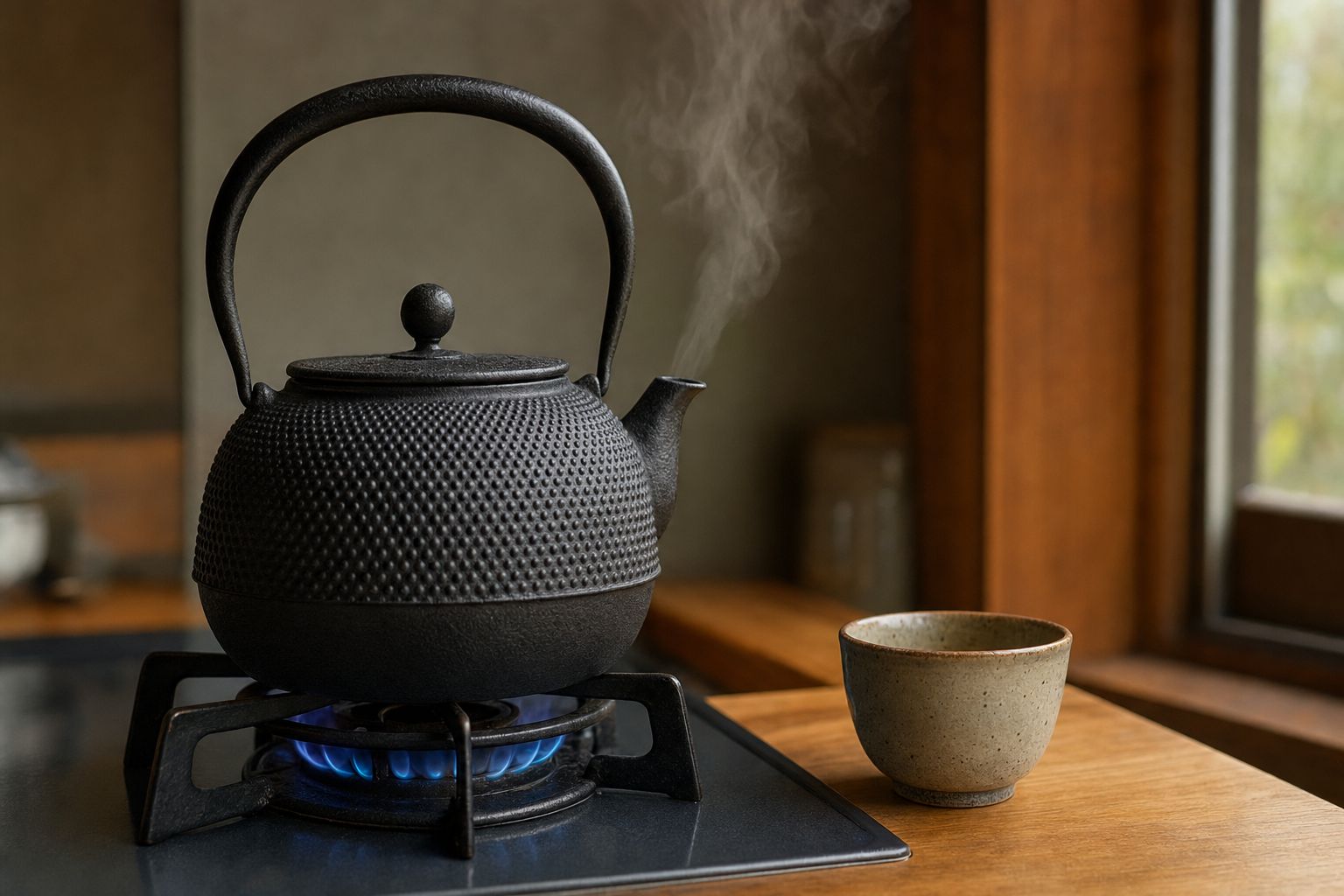
Search “tetsubin” outside Japan and most of what comes up is small, glossy, and enamel-lined on the inside — a squat black teapot with a side handle, sold in a gift box with two thimble-sized cups. It looks the part. It is also, technically, not a tetsubin. That glaze on the inside is the whole tell: a real tetsubin has none.
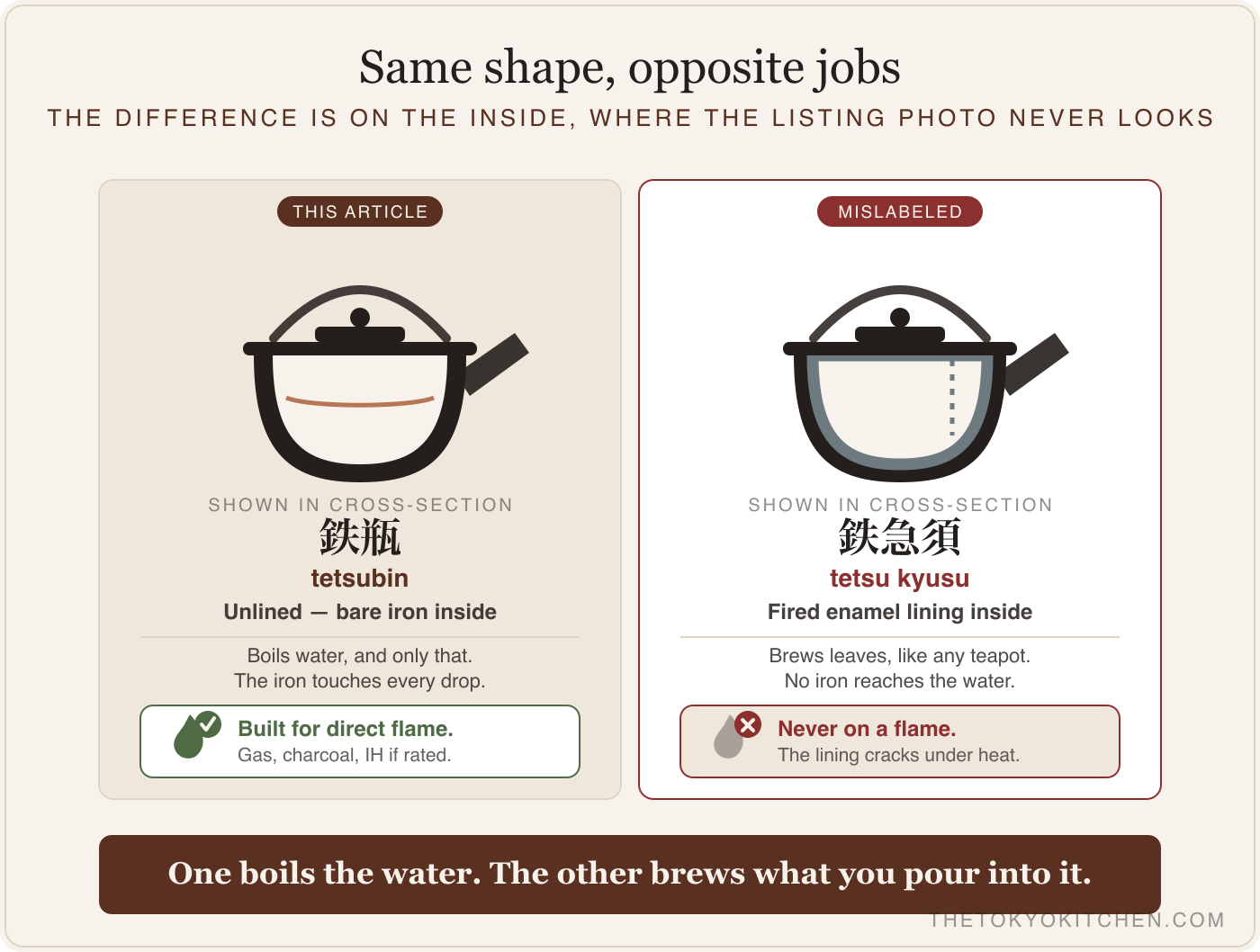
The short answer: a tetsubin (鉄瓶) is a cast iron kettle — bare iron inside, made to sit directly on a flame and boil water, nothing else. The enamel-lined version sold abroad as a “Japanese teapot” is a different product, called a tetsu kyusu (鉄急須), designed to brew tea and explicitly not to go anywhere near open fire. Mixing the two up is the reason a lot of people own a beautiful cast iron object they’re quietly unsure how to use.
Two objects, one shape
The confusion is understandable, because from across a kitchen the two look almost identical.
The difference is on the inside and in the job description.
A tetsubin is unlined. Bare iron sits in direct contact with the water every time you boil it, and that contact is the point — the metal releases trace amounts of iron into the water as it heats, which is part of why people who use one talk about it changing the taste of their tea rather than just heating water for it. Because there’s no glaze protecting the surface, a tetsubin can go straight on a gas burner, a charcoal brazier, or an induction stove if the base is made for one — check before you buy, because plenty of traditional models aren’t.
A tetsu kyusu, by contrast, has a fired-in enamel coating on the inside. That coating is why it’s built for brewing loose-leaf tea rather than boiling water — it won’t leach iron, it won’t rust, and it should never touch a flame, because the coating can crack under direct heat the way a glazed mug shatters in an oven. It’s a lovely object. It is a teapot, not a kettle, and the listing that calls it a “tetsubin teapot” is quietly asking you to use it the wrong way.
If you already know a kyusu — the everyday clay teapot most Japanese kitchens actually pour from — think of the tetsu kyusu as its cast iron cousin. The tetsubin is a completely different tool: the thing that boils the water before any teapot gets involved.
Where the iron comes from
The craft behind most of what you’ll find labeled tetsubin traces back to Morioka, in Iwate Prefecture, in the early 1600s. The Nanbu clan, ruling the domain from a newly built castle, invited a kettle-maker down from Kyoto to produce chagama — the large iron kettles used in the tea ceremony — and the region’s iron-rich ground did the rest. Metalworkers converged on the area, and by the Edo period local casters had scaled the chagama down into something a household could actually own and pour from: the tetsubin as it’s recognized today.
That lineage is called Nanbu tekki, and in 1975 it became the first craft in Japan to receive official Traditional Craft status. The surface texture you’ll see on a lot of tetsubin — small raised bumps arranged in a grid — is arare (霰, “hail”), and it isn’t decoration for its own sake. It increases the kettle’s surface area, which helps it heat a little faster and more evenly.
What boiling in bare iron is actually doing
The trace iron a tetsubin releases is genuinely small. I’d treat any claim about meaningful daily iron intake from one with real skepticism — this is a kettle, and it should stay one. (I’m not a doctor, and if you’re managing iron levels for a medical reason, that’s a conversation to have with an actual one.) What people more consistently notice is water taste: boiling in cast iron tends to soften the sharp edge of tap water and mellow chlorine’s flat, slightly metallic note, the same rounding effect you get from a Brita filter, just by a different mechanism.
A new tetsubin also needs to build its own protection before it’s fully trustworthy. Boil plain water in it repeatedly over the first few weeks — nothing else, no tea leaves — and a thin, dark mineral layer forms on the interior. That layer is doing the same job an enamel coating does on the tetsu kyusu, just grown from the kettle’s own use instead of fired on at the factory. Skip this step and rush straight to daily use, and you’re more likely to end up nursing a rust problem within the first year.
The habit that actually matters
Never leave water sitting inside after use — empty it while it’s still hot, so the residual heat finishes drying the interior on its own. Soap and a dishwasher are both off the table too. If a stain or light discoloration builds up on the inside, leave it alone — that’s the protective layer doing its job, and scraping at it is the single fastest way to expose fresh iron underneath and invite the rust you were trying to avoid.
If red, flaking rust does show up, the traditional fix is unglamorous and works: boil water with a small handful of used tea leaves two or three times in a row. The tannins react with the exposed iron and rebuild a darker, more stable layer over it. It’s not a full repair for a kettle that’s been badly neglected, but for the ordinary “I forgot it was still half full for a week” mistake, it’s usually enough.
What to actually buy, and what to skip
Contemporary Iwachu tetsubin — the everyday, factory-cast version most people abroad actually own — run around $120 for a mid-size kettle, which buys you real Nanbu tekki manufacturing rather than a decorative import wearing the name. Hand-forged pieces from named Morioka studios sit in a different world entirely: $450 to $3,000 depending on the maker, size, and how much of the arare pattern was placed by hand rather than mold.
I’d skip two things. First, anything listed as a “tetsubin teapot” with no mention of whether the interior is lined — that phrasing is doing exactly the job I described above, blurring two products into one so nobody asks the inconvenient question. Second, unbranded kettles with no maker or region named at all; Nanbu tekki isn’t the only cast iron tradition in Japan, but a listing that can’t say where the kettle was cast usually can’t tell you much else about it either, including whether the iron is any good.
And the honest downside, even on a real one: it’s heavy, it’s one more thing in the kitchen that punishes neglect, and unless the base is specifically rated for it, it’s not going anywhere near an induction stove. A stainless kettle is still the more forgiving daily object. A tetsubin earns its place for the ritual and the taste; practicality is a separate argument, and it doesn’t really win.
Where it actually sits in a day
My mornings start with green tea, coffee somewhere in the mix, and by evening I’ve switched to mugicha or hojicha specifically because neither has caffeine in it — a household rule by now more than a decision I make each night. A kettle that’s already on the stove for all of that, without a cord or a plastic reservoir, ends up doing more quiet daily work than almost anything else in the kitchen.
It also isn’t a luxury import here. Walk down the tea aisle of an ordinary Japanese supermarket and you’ll find dozens of loose-leaf options at prices that make brewing at home — kettle, leaves, five minutes — cheaper than buying it bottled, which is a large part of why so many households still keep some kind of kettle going rather than relying on the convenience store fridge. The tetsubin is simply the traditional, higher-maintenance branch of that same habit.
So, which one
If the goal is brewing loose-leaf tea day to day, start with a kyusu — it’s cheaper, far more forgiving, and it’s the pot actually doing the steeping in a Japanese kitchen. Add a tetsubin later, specifically for boiling, once you’re sure you’ll keep up with the drying habit. Buy the two as separate tools for separate jobs, the same logic that applies to picking one good knife instead of a twelve-piece block or choosing a cutting board that actually matches how you cook rather than collecting equipment that overlaps.
Mine sits at the back of the stove, filled and emptied most days, and it will probably outlast the stove itself. That’s really the whole pitch: buy it for the decades, not the first cup.
— Sen
Want the short version?
The One-Knife Kitchen: how to choose and care for the single Japanese knife that replaces the block — free, printable, one page.
Send me the free guide →