Kitchen Tools
Japanese Rice Cookers: What a $500 Price Tag Actually Buys You
Show a $500 Japanese rice cooker to someone outside Japan and the reaction is almost always the same: it’s a box that boils rice and water, so why does it cost more than a decent microwave. I used to half-agree with that, until I actually looked into what separates the cheap end of the lineup from the expensive end.
Almost none of it is marketing.
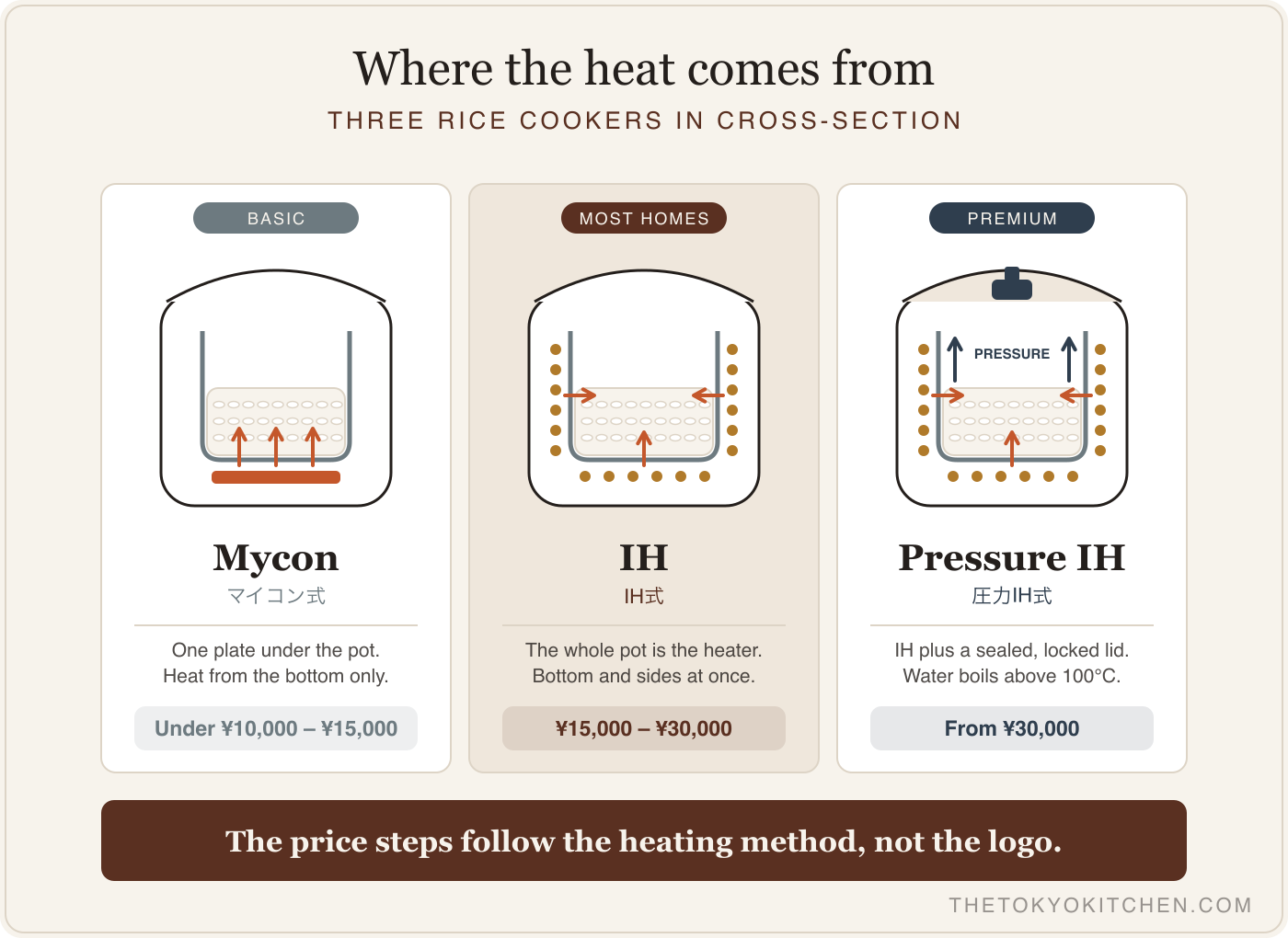
The short version: the price jump in a Japanese rice cooker tracks the heating method, not the brand name on the lid. A basic mycon (microcomputer) model heats from a plate under the pot, the way a cheap hot plate does. Step up to IH and the whole pot becomes the heating element. Step up again to pressure IH and the machine raises the boiling point of the water inside, which actually changes the texture of the rice itself. Each step buys something real. Whether you need it is a separate question, and for most households, the honest answer is no.
Three heating methods, three different machines
A mycon rice cooker has a single heating plate at the bottom of the pot, the same basic principle as an electric kettle. It heats from one direction, which means the bottom of the rice cooks a little faster and hotter than the top, and on anything past a small batch you’ll notice some unevenness — a slightly firmer bottom layer, a softer top. It’s the cheapest category, and it’s genuinely fine for someone cooking rice occasionally in small amounts.
IH — induction heating — skips the heating plate and turns the inner pot itself into the heat source, using the same principle as an induction stovetop. Heat comes from the whole vessel at once rather than one plate underneath it, so the grains cook more evenly from edge to edge. This is where most mid-range Japanese household cookers sit today.
Pressure IH adds a sealed lid and a small amount of built-up steam pressure, which pushes the water’s boiling point above the normal 100°C. Rice cooked at a slightly higher temperature gelatinizes faster and more completely, and that’s the actual mechanism behind the “plumper, glossier” grain texture the premium models advertise. It isn’t a gimmick word for marketing copy. It’s genuine physics, just applied to a pot of rice instead of a chemistry lab.
What this actually costs, start to finish
In Japan, a basic mycon rice cooker starts under ¥10,000 and rarely goes much past ¥15,000. Mid-range IH models generally run ¥15,000 to ¥30,000. Pressure IH starts around ¥30,000 and climbs fast from there — Zojirushi’s flagship 炎舞炊き (Honoomai-daki) line, for example, runs about ¥69,080 for the 5.5-cup NW-NA10 at full retail price, and Tiger’s clay-pot-style 土鍋ご泡火炊き launched at a store estimate of roughly ¥120,000 when it came out in 2025. Above ¥50,000, you’re mostly paying for incremental heating precision and cooking-mode variety rather than any new physical principle — the jump from mycon to IH to pressure IH is where the real difference lives, and the five-figure gap above pressure IH’s entry price buys diminishing returns.
None of this is specific to one brand. Zojirushi and Tiger are the two names you’ll see most in Japanese department stores, with Panasonic and Mitsubishi Electric also selling pressure IH lines, and the competition between them is mostly about cooking-mode software and inner-pot coating rather than the underlying heating category.
Tacook: cooking the side dish in the same pot
Tiger sells a feature across several of its mid-range lines called tacook, which is a removable steaming plate that sits inside the pot above the rice. You put a side dish on the plate — a piece of fish, some vegetables — and the cooker steams it at the same time the rice cooks underneath, without the flavors mixing into the rice. It’s a genuinely clever use of the leftover steam a rice cooker generates anyway, and it comes bundled with a small recipe booklet on the models that include it. It won’t replace a stovetop for anything that needs browning or searing, but for someone who actually wants dinner and rice ready at the same moment with one appliance running, it’s one of the more useful mid-range features in the category — not just a line on a spec sheet.
The rinse-free setting almost nobody outside Japan knows about
Most rice sold in Japan still needs rinsing before cooking, to wash off surface starch and bran dust left over from milling. But a category called musenmai (無洗米, literally “no-wash rice”) has its surface starch removed at the mill instead, so it goes straight into the pot. Most Japanese rice cookers have a musenmai marking on the inner pot’s water line, because musenmai needs slightly more water than ordinary rinsed rice to cook to the same texture — the water line for washed rice is calibrated assuming you’ve rinsed away some of that surface starch, and musenmai never had it to begin with. If you buy a bag of musenmai and measure water against the regular line instead, the rice comes out a touch firmer than it should.
For scale: our kitchen has about four knives, which I think is roughly normal for a Japanese home. The rice cooker gets used far more often than any one of them, and I suspect that’s true in most Japanese households.
The voltage trap for anyone buying one outside Japan
Here’s the part that trips up a lot of overseas buyers specifically. Japan runs on 100V household power. The US runs on 120V. Most of Europe and a lot of Asia runs on 220–230V. Rice cookers sold inside Japan are built for 100V, full stop — and the flagship pressure IH models, the ones generating all the online buzz, are mostly sold only in that domestic 100V version.
What you’ll find marketed as an “overseas” or “export” Zojirushi model, like the Neuro Fuzzy NS-ZCC10 built for 120V regions including the US, is typically a simpler microcomputer-controlled cooker, not the pressure IH flagship. Other export units are built for 220–230V instead, with a completely different plug shape. None of this is a universal rule enforced by physics alone — some small appliances tolerate a voltage mismatch without much drama — but a rice cooker’s heating and timing circuits are calibrated for a specific voltage, and manufacturers are explicit that running one on the wrong supply, or without the right step-down or step-up transformer, risks the control board and voids any warranty. If you’re buying one while in Japan to bring home, or ordering an import listing, check the nameplate on the back for the actual voltage spec before anything else — the model number alone won’t tell you.
So, which one actually
If you cook rice a few times a week and don’t obsess over grain texture, a mid-range IH cooker does the job without the premium markup, and it’s the category I’d actually recommend to most people reading this from outside Japan. If you eat rice daily and have strong opinions about the difference between glossy and merely fine, pressure IH is where that opinion gets satisfied, and the ¥30,000-to-¥70,000 range covers the real jump without chasing the six-figure flagship models that mostly buy you extra cooking presets. What I’d skip is a sub-¥10,000 mycon model for anyone eating rice as a daily staple. The uneven bottom layer is a real, repeatable problem that shows up every single time you cook more than a cup or two — it’s not a one-off complaint from a single bad batch.
A rice cooker is a strange thing to get sentimental about, but it earns its spot the same way a tetsubin earns its place at the back of the stove or a good donabe earns its place for the one dish it does better than anything else — bought once, used daily, and quietly outlasting almost everything else in the kitchen around it. If you’re still building out the rest of a Japanese kitchen from scratch, start with the knife before the rice cooker; one good blade changes more dinners than the pot does.
— Sen
Want the short version?
The One-Knife Kitchen: how to choose and care for the single Japanese knife that replaces the block — free, printable, one page.
Send me the free guide →