Kitchen Tools
Otoshibuta: The Japanese Drop-Lid Behind Real Nimono (and Why a Regular Pot Lid Can't Replace It)
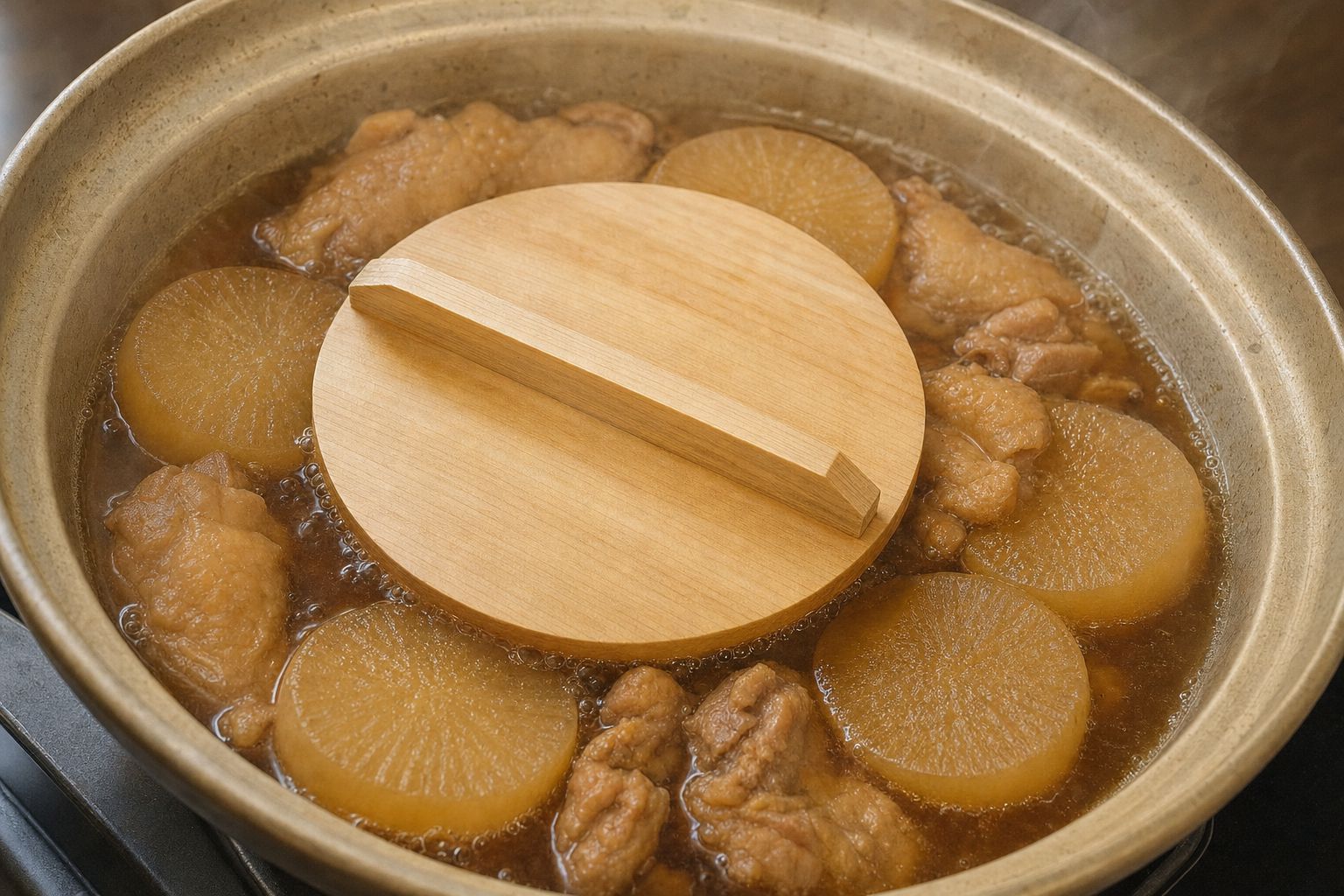
Open almost any Japanese recipe for simmered daikon, or chicken and potatoes in soy-dashi broth, and you’ll hit an instruction that makes no sense if you’re picturing a Western pot lid: “cover with an otoshibuta.” Not the lid that came with the pot. A different, smaller lid, and it doesn’t sit on the rim at all.
It sits on the food.
The short answer: an otoshibuta is a round lid — traditionally wood, now also silicone or stainless steel — cut a size or two smaller than the pot it’s used in, so it drops down inside and rests directly on the simmering ingredients instead of on the pot’s edge. That direct contact does three things a regular lid propped up on the rim can’t: it keeps the liquid circulating evenly over everything without you stirring, it physically holds delicate pieces in place so they don’t knock against each other and break apart, and it lets flavor and heat reach the top layer of food almost as fast as the bottom. A Western lid traps steam above the food. An otoshibuta pushes gently down on the food itself. Below: what the wood actually does, when you want silicone or paper instead, and what this thing should cost you.
The lid that doesn’t sit on the pot
Most people’s first reaction to an otoshibuta, in person, is that it looks like someone grabbed the wrong lid — one clearly too small for the pot in front of them.
That’s the entire design. A standard pot lid rests on the rim and seals a dome of steam above the food, which is exactly what you want for rice or pasta. Nimono — Japanese simmered dishes, the category this tool exists for — isn’t cooked that way. The liquid level is usually shallow, barely covering the ingredients, and the goal is for everything to cook through evenly in that thin layer without being stirred to death, because stirring is how simmered daikon turns into mashed daikon. An otoshibuta solves that by floating right on the surface: as the liquid bubbles underneath it, it gets pushed up against the lid and redirected back down over the top of the food, basting everything in its own broth the entire time it cooks. Ingredients also stay physically pinned in place instead of bobbing and colliding, which is the difference between a pot of kabocha squash that holds its shape and one that’s broken into pale orange rubble by the time it’s done.
A regular lid, even cracked open, doesn’t do either of those jobs. It just holds in steam.
Wood, silicone, paper — and what you lose with each
Wood is the traditional material, and it’s usually cedar (sugi) or one of the Japanese cypress woods — sawara is the specific wood the Tokyo knife-and-tool shop Kiya uses for its drop lids, sourced from the Kiso Valley in Nagano Prefecture, where sawara was historically one of the “Five Trees of Kiso” that commoners were banned from felling under Edo-period forestry law, prized for resisting rot even when it’s constantly wet. Kiya itself is not a new company; the shop has been selling cutlery and kitchen tools in Nihonbashi since 1792. Wood’s advantage is weight: it presses down slightly on its own, which helps hold heavier cuts like simmered pork belly or whole chicken pieces in place without you doing anything.
That same weight is a liability with fragile ingredients. Delicate vegetables — kabocha, turnips, anything already starting to soften — can get crushed under a solid wood lid once they’ve simmered past a certain point. For those, the usual fix is a sheet of parchment paper, cut to the pot’s size with a hole or two vented at the center, laid on top of the food instead. It does the same circulating, basting job with none of the weight. A sheet of foil, pressed down snugly, is the version everyone’s actually used at some point, usually without knowing it had a name.
The newer options are a step more practical and a step less traditional. Silicone drop lids, and adjustable stainless steel ones with little expanding flaps, both solve a problem wood never did: wood needs to be a specific size for your pot, and if you don’t own the right one, you’re improvising with foil anyway. An adjustable stainless design — the Wahei Freiz brand’s version shows up often in this category — expands or contracts to roughly fit whatever pot you’re using, resists soaking up the smell of whatever you simmered last, and goes straight in the dishwasher. Wood goes in no dishwasher, ever.
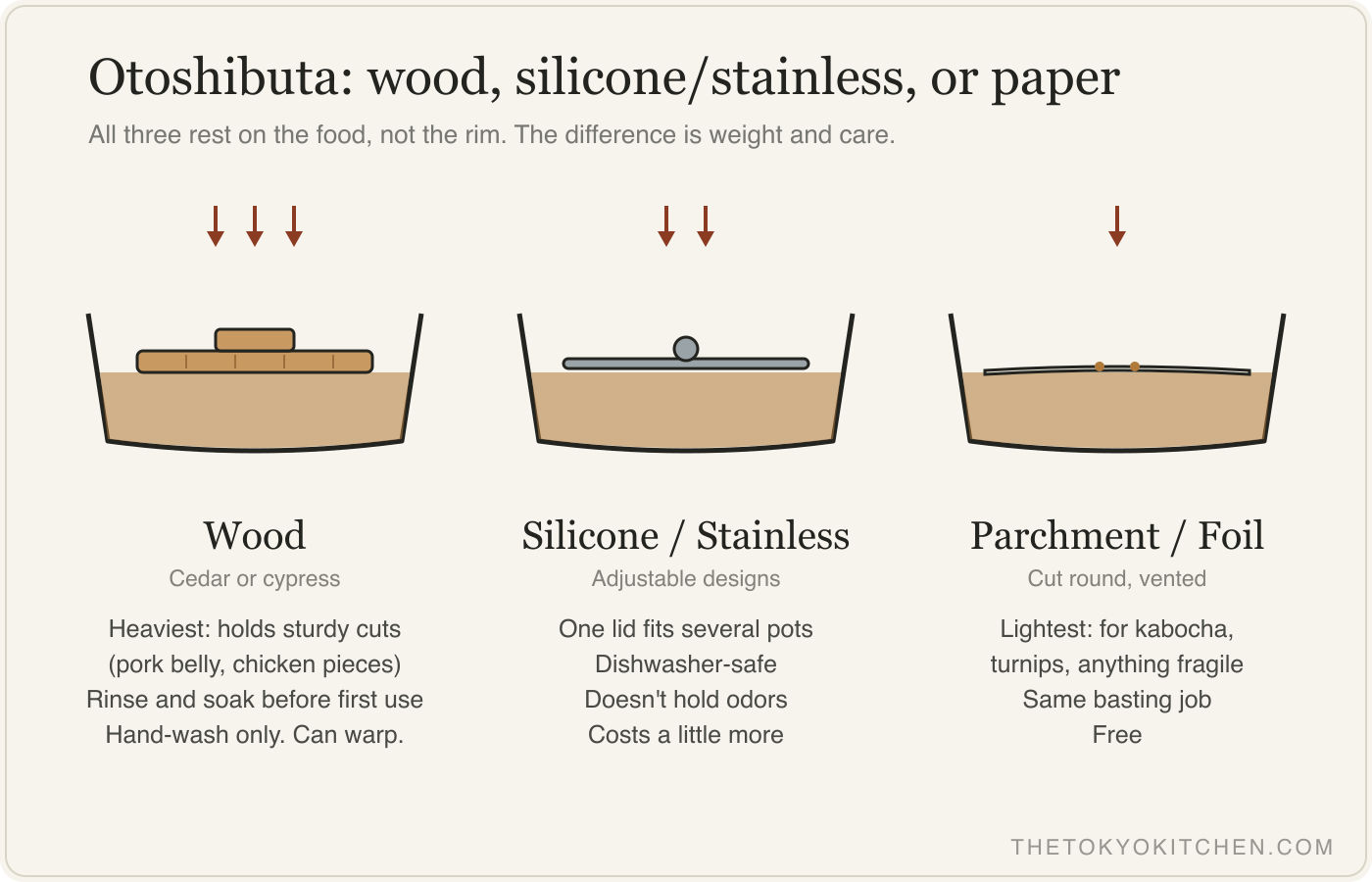
None of these is strictly “the right one.” Wood is the classic choice for sturdy, heavier ingredients and the look most cookbooks show. Silicone and stainless are the realistic choice if you cook nimono more than occasionally and don’t want a drawer full of lids in five different diameters. Parchment is the honest answer for anything that would otherwise fall apart.
Sizing it, and the one mistake that defeats the whole point
The lid has to be smaller than the pot — by a noticeable margin, not a fraction of an inch. A common rule of thumb is to size it a couple of centimeters narrower than the pot’s interior, so it can actually drop down and rest on the food rather than catching on the rim like a slightly undersized regular lid would. If you’re cutting your own from parchment, fold it into quarters, trim the curved edge to roughly match the pot, and snip a couple of small vents near the fold before unfolding it.
New wood lids are also usually sold raw, with nothing done to them beyond the cut and a hand-wash recommendation on the packaging. A quick rinse and a few minutes sitting in hot water before the first real use is the common-sense step most sellers and cooks suggest, mainly to soften the raw cypress or cedar smell before it has a chance to transfer into your broth. Skip it and the first dish you make might pick up a faint woody edge to the flavor — not dangerous, just not what you were going for.
The mistake that actually defeats the tool is using a lid that’s the same diameter as the pot, or close to it. At that size it just behaves like a badly fitting regular lid: it either rests on the rim and traps steam above the food, or it tips and jams at an angle instead of lying flat on the surface. Either way, you’ve bought a specialty tool and then used it to do a worse version of what the lid you already own does fine.
Care, and why wood doesn’t last forever
Rinse a wood otoshibuta right after use, scrub it without soap worked deep into the grain, and dry it standing on its edge rather than flat, so air actually reaches both sides. Leave it wet and flat on a dish rack and it’ll warp slightly over time — not shatter like ceramic, just bow enough that it no longer sits flush, which quietly undoes the whole point of the tool.
That warping is the honest flaw nobody puts on the product listing. A wood drop lid used regularly for a few years will eventually cup or bow a little, the same way a wooden cutting board does, and at that point it stops floating flat on the food the way it’s supposed to. It’s not a defect so much as a wood object doing what wood objects do with repeated wet heat. Silicone and stainless don’t have this problem, which is the actual argument for paying more for one of them rather than any claim about better cooking results.
What this actually costs
| Type | Example | Price | Who it’s for |
|---|---|---|---|
| Small wood lid (cedar or cypress) | A basic 16cm/6.3” Japan-made cedar drop lid | Roughly $6–$20 | A first otoshibuta, one specific pot size |
| Cypress drop lid from a specialty maker | Kiya’s Kiso sawara wood lid, ~14–18cm | Around $17 | Buying into a specific maker’s reputation, not just the function |
| Adjustable stainless steel | Wahei Freiz-style expanding drop lid | About $25–$26 | One lid for multiple pot sizes, dishwasher-safe |
| Free | Parchment paper or foil, cut to fit | $0 | Delicate ingredients, or trying the technique before buying anything |
The expensive option here tops out under $30. This is not a tool anyone needs to agonize over.
The honest recommendation
Don’t buy a wood drop lid for every pot size you own — buy one sized for the pot you actually simmer things in most, and use parchment for the rest. If you cook nimono often enough to be annoyed by the sizing hassle, the adjustable stainless version earns its slightly higher price by fitting more than one pot and surviving the dishwasher, which a cedar lid never will.
What it isn’t, in any material, is optional for the dishes it’s built for. The donabe that a lot of these same simmered meals end up cooked in gets name-dropped constantly in the same recipes, and the two tools are usually working together — one holding heat, the other keeping what’s inside it intact. The knife that got the daikon and chicken into the pot in the first place and the suribachi grinding the sesame dressing on the side are the other two unglamorous tools doing most of the actual work in a Japanese kitchen, usually for less money than people expect. If this is the first of the three you’re adding to your own drawer, it’s also the cheapest place to start.
Quick recap: an otoshibuta sits on the food, not the rim. Wood suits sturdy cuts, parchment suits anything fragile, and adjustable stainless is the one-lid-for-every-pot answer. Whatever you pick, size it clearly smaller than the pot.
What’s the one pot you simmer in most? Measure its inside diameter tonight, subtract a couple of centimeters, and that’s the only number you need before buying.
Osomatsu! (It was nothing.)
— Sen
Want the short version?
The One-Knife Kitchen: how to choose and care for the single Japanese knife that replaces the block — free, printable, one page.
Get the free guide →