Kitchen Tools
Suribachi: The Japanese Mortar and Pestle Behind Real Goma-ae (and Why a Blender Can't Replace It)
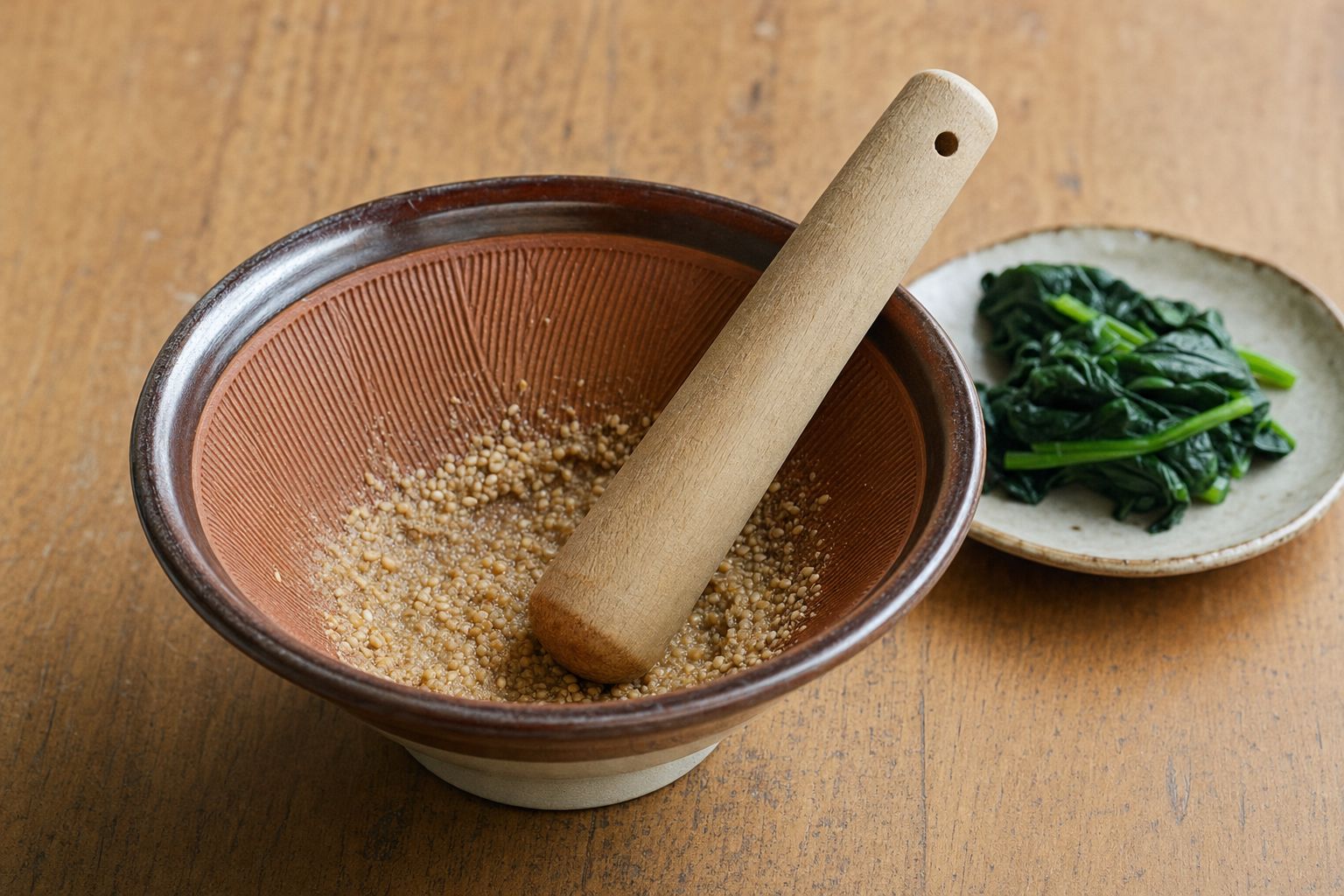
Every goma-ae recipe online tells you to grind the sesame. Almost none of them mention that the bowl matters as much as the grinding, and that most kitchens in Japan still reach for one very specific unglazed bowl to do it instead of a food processor.
It’s called a suribachi, and it’s been sitting in Japanese kitchen cupboards since well before anyone outside the country noticed it existed.
The short answer: a suribachi is a ceramic mortar with a deliberately rough, ridged, unglazed interior, used with a wooden pestle called a surikogi — never metal, never plastic, because anything harder than wood wears the ridges down over time. Those grooves, called kushime, are what actually do the grinding; the pestle just applies the pressure and the turning motion. A blender or spice grinder can pulverize sesame seeds in two seconds, but it purees them and warms the oil in the process. A suribachi tears the seeds open slowly and keeps the paste cooler and coarser, which is the texture real goma-ae and nerigoma are supposed to have. Below: the two ceramic traditions that still make these, how to actually use one, and where the money goes if you’re buying your first.
A bowl that’s meant to be rough
Most ceramics get smoother as a point of pride. A suribachi is built to stay rough on purpose — the inside third to half of the bowl is left unglazed and carved with fine, overlapping grooves before firing, so the clay itself becomes a grinding surface instead of just a container.
That’s also why the pestle rules are strict. A metal spoon or a rubber spatula scraped against those grooves will shred against the serrated clay and leave bits of rubber behind; worse, over years it flattens the ridges that make the whole tool work. The surikogi has to be wood, and in Japan it’s traditionally a specific wood: sansho, the same tree the peppercorn-like spice comes from. Sansho is hard, dense, and slow-growing, and old kitchen wisdom treated it as naturally hygienic enough to trust with food, long before anyone had a word for food safety. Whether that belief holds up scientifically is a separate question. What’s not in dispute is that it’s tough enough to survive decades of grinding against rough clay without splintering.
Two kilns, same idea
“Suribachi” isn’t a brand, and almost everything sold under that name in Japan today comes from one of two pottery regions.
Mino ware is centered on Tajimi and Toki, in Gifu Prefecture, and it’s less a single style than the dominant supplier of ordinary Japanese tableware — it’s estimated to account for more than half of everyday tableware made in the country. Most of the plain, grey, ridged suribachi you’ll find sold outside Japan, often under commercial kitchenware brands, come out of this region. It’s the workhorse option: reliable, inexpensive, nothing fancy about the glaze.
Tokoname ware, from Aichi Prefecture, is one of Japan’s “Six Ancient Kilns” (Rokkoyo) — a pottery tradition that traces back to the early 12th century, making it the largest of the six by output. According to Aichi’s own ceramics museum, suribachi-style grinding bowls were already one of the basic everyday products coming out of the Tokoname kilns back in the medieval period — this isn’t a tool that got invented for a cooking show. A handful of family workshops there still specialize almost entirely in suribachi, down to the width and depth of the grooves.
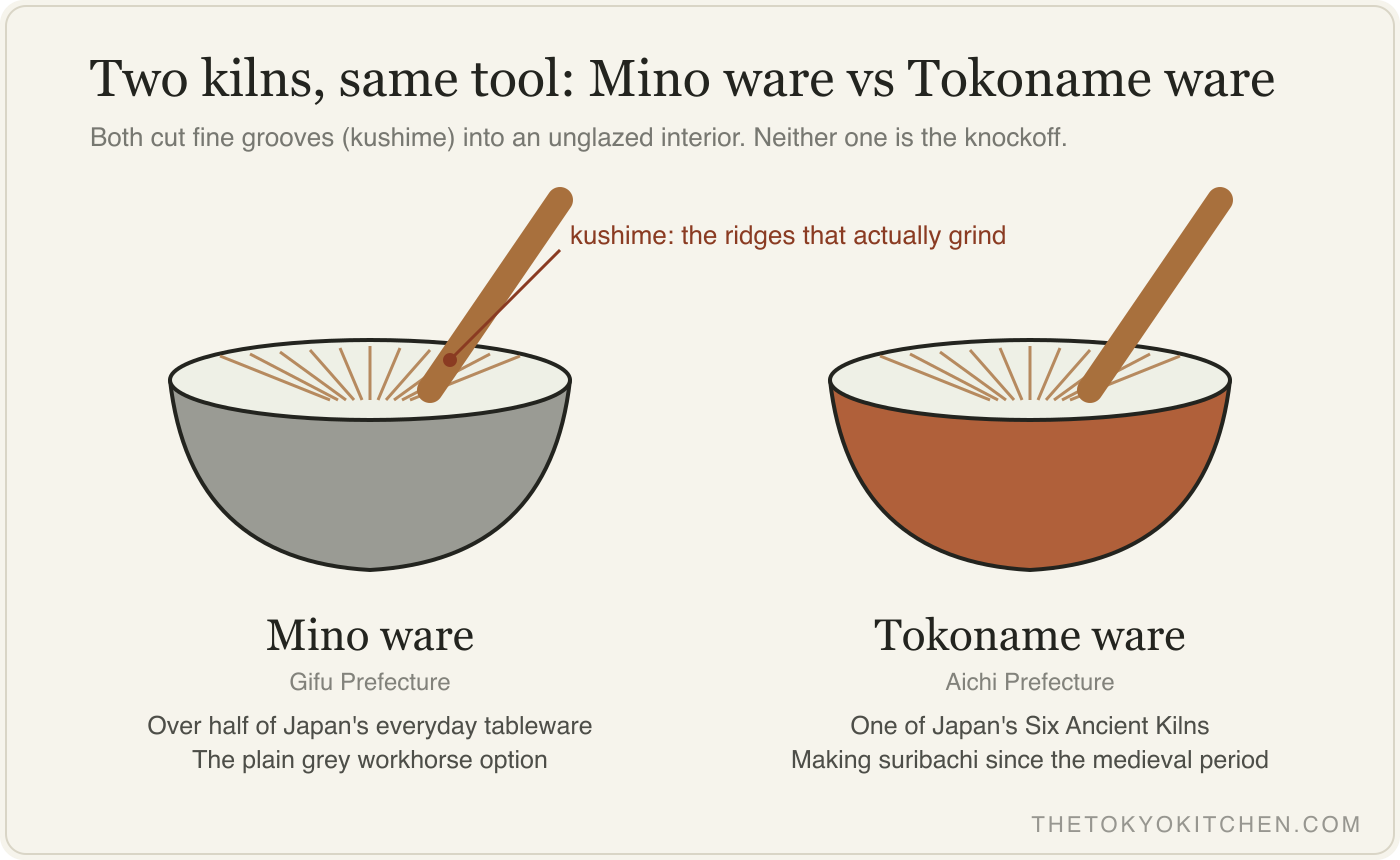
Neither one is the “authentic” version and the other a knockoff. One is the everyday workhorse; the other is the deeper-rooted specialist. Most Japanese households just end up with whichever one was in the house already, not the one they researched and chose.
What it’s actually for
The textbook use is goma-ae — toasted sesame seeds ground into a dressing for spinach, green beans, or whatever vegetable needs a reason to get eaten. You dry-toast the seeds first, then grind them while they’re still warm, one hand resting on top of the pestle and the other lower down, turning it in slow circles instead of pounding straight down. Let the pestle’s own weight do the work rather than leaning on it.
Set the bowl on a damp dish towel or a rubber mat first. A suribachi has no flat rubber base, and a bowl sliding across the counter while you’re grinding sesame is how you end up with sesame paste on the floor.
Past sesame, the same bowl handles nerigoma (sesame paste, built by working in oil a little at a time after grinding), and it’s traditionally where tsukune — Japanese chicken meatballs — get their sticky, bound texture, by grinding the ground chicken itself rather than just mixing it. A spice grinder or food processor will technically do all three jobs faster. It will also over-process everything into a uniform paste in about four seconds, which is exactly the texture goma-ae isn’t supposed to have. If you’re making a full bag of sesame dressing for twenty people, use the processor — nobody’s grinding that much by hand. For a weeknight side dish for two, the suribachi is not actually slower once you factor in cleanup.
Where I come up short
My wife’s family is from Tango, on the Kyoto side of the coast most tourists never make it to. Every winter there, dinner is buri-shabu — thin slices of winter yellowtail swished through broth in a donabe at the center of the table.
What I can’t tell you is whether any of the sauces on that table started life in a suribachi or in a bottle from the supermarket. I’ve never asked, and it’s on my list for the next visit instead of just eating.
Care, and the one honest flaw
Day to day, the rules are short: rinse with warm water right after use, scrub gently with a bristle brush rather than soap worked deep into the grooves, and dry it fully before it goes back in the cupboard. Skip the dishwasher — the water jets won’t clean the ridges properly, and the thermal cycling isn’t kind to unglazed clay.
Here’s the part sellers don’t put in the listing: even cared for properly, the ridges wear down over years of regular grinding. A suribachi used two or three times a week for a decade eventually goes smoother and less effective than the one you bought, and at that point it’s just a slightly textured bowl. That’s not a defect. It’s a consumable surface doing its job slowly, the same way a cutting board eventually needs resurfacing.
What it actually costs
| Type | Example | Price | Who it’s for |
|---|---|---|---|
| Small Mino ware mortar (bowl only) | Basic Gifu-made ceramic suribachi, roughly 4” diameter | About $10–20 | A first suribachi, occasional goma-ae |
| Mino or Tokoname mortar-and-pestle set | Ceramic bowl with matching wood pestle, 6–7” diameter | About $40–75 | Regular use, gifting |
| Tokoname specialty piece | Family-workshop suribachi, similar size | Around $40 and up | Buying into the specific kiln tradition |
The cheap end isn’t a compromise. A $12 Mino ware bowl grinds sesame exactly as well as a $75 set — what the extra money buys is a matching wooden pestle, a specific kiln’s reputation, and sometimes a nicer glaze on the outside rim rather than more grinding power.
The honest recommendation
Buy the small, plain Mino ware bowl if you actually cook Japanese side dishes with any regularity and you’re tired of your blender turning sesame dressing into gritty sesame butter. Skip the decorative glazed versions sold as souvenirs with shallow, barely-there grooves; they look the part sitting on a shelf and grind almost nothing, because the ridges that matter are the ones manufacturers cut corners on first.
It’s a grinding tool, not a decoration, and it earns a spot in the cupboard on exactly that basis. The donabe doing the actual simmering at the table and the knife that got everything into the pot in the first place are the two tools a suribachi usually sits next to in a Japanese kitchen drawer, and if the whole conversation has you rethinking what else in there deserves an upgrade, the tamagoyaki pan is a good next stop.
— Sen
Want the short version?
The One-Knife Kitchen: how to choose and care for the single Japanese knife that replaces the block — free, printable, one page.
Get the free guide →